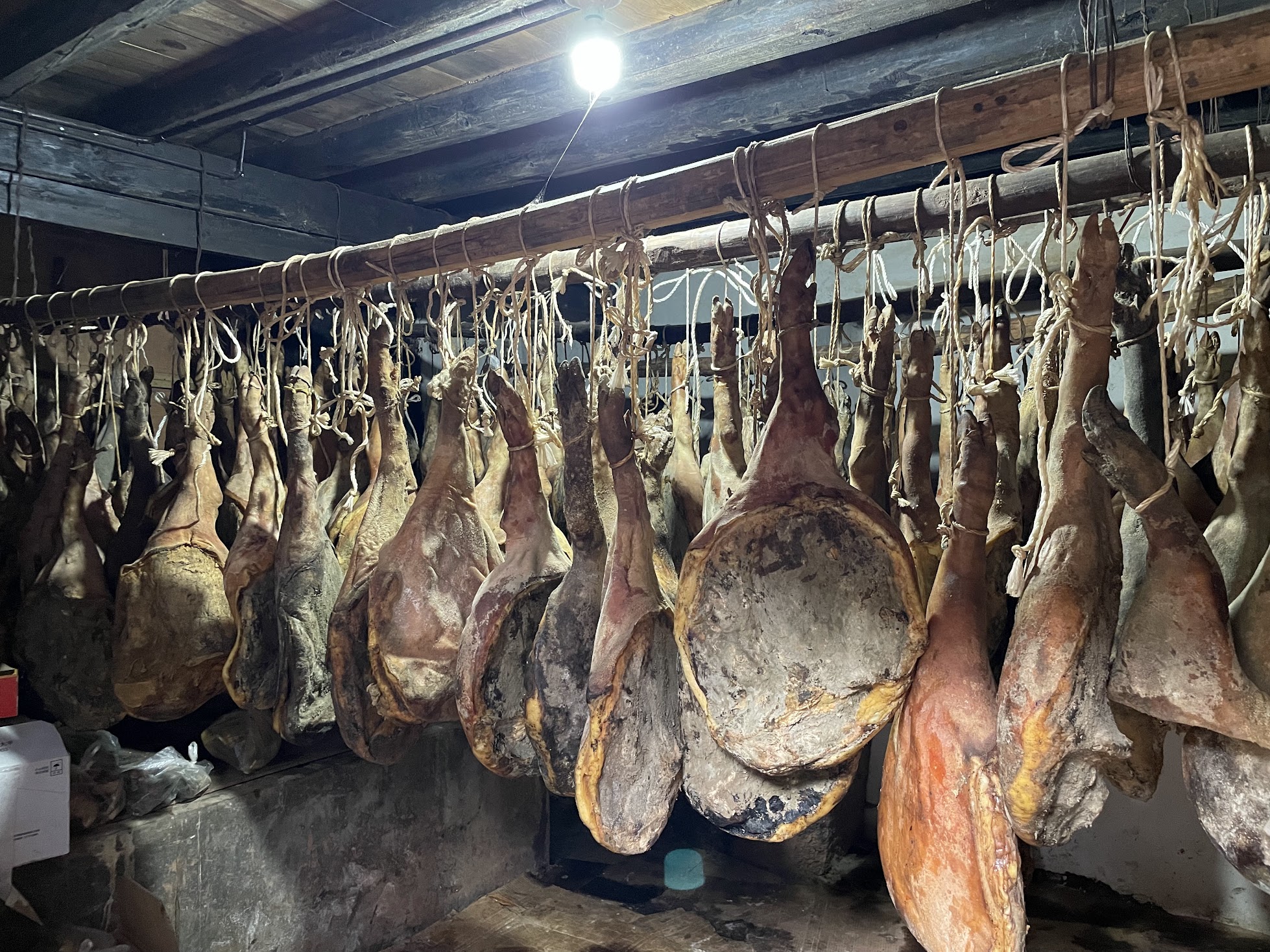
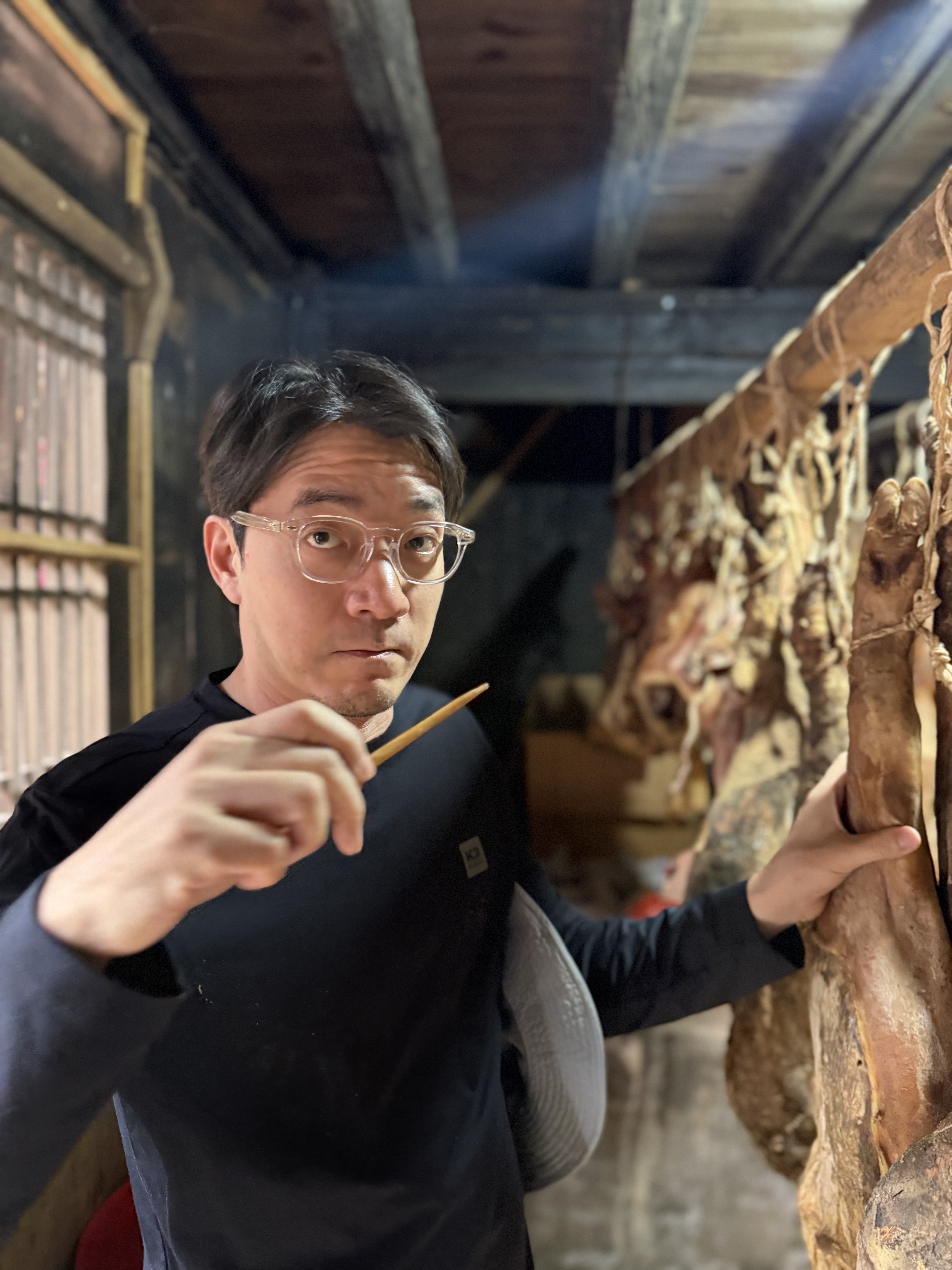
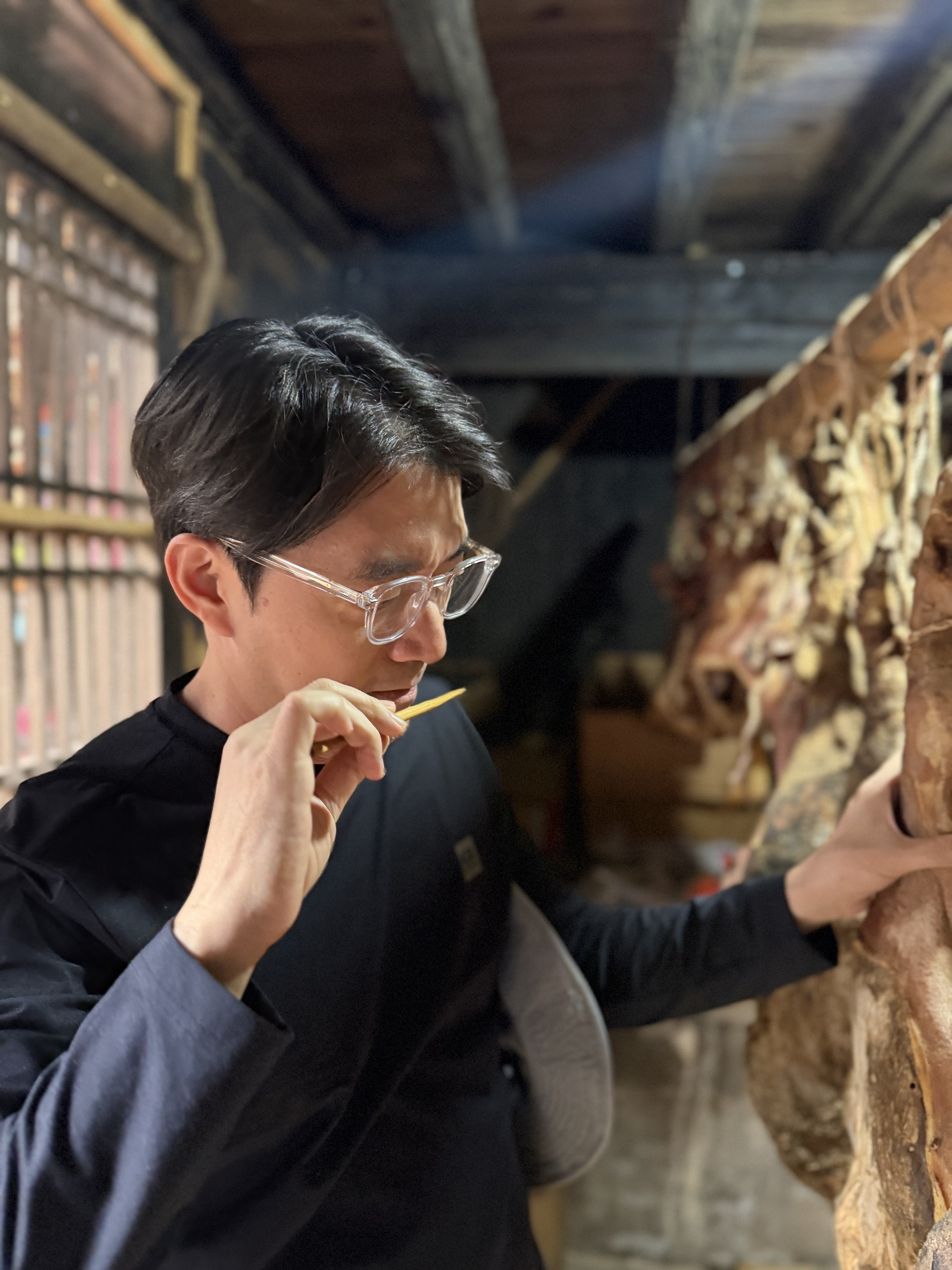
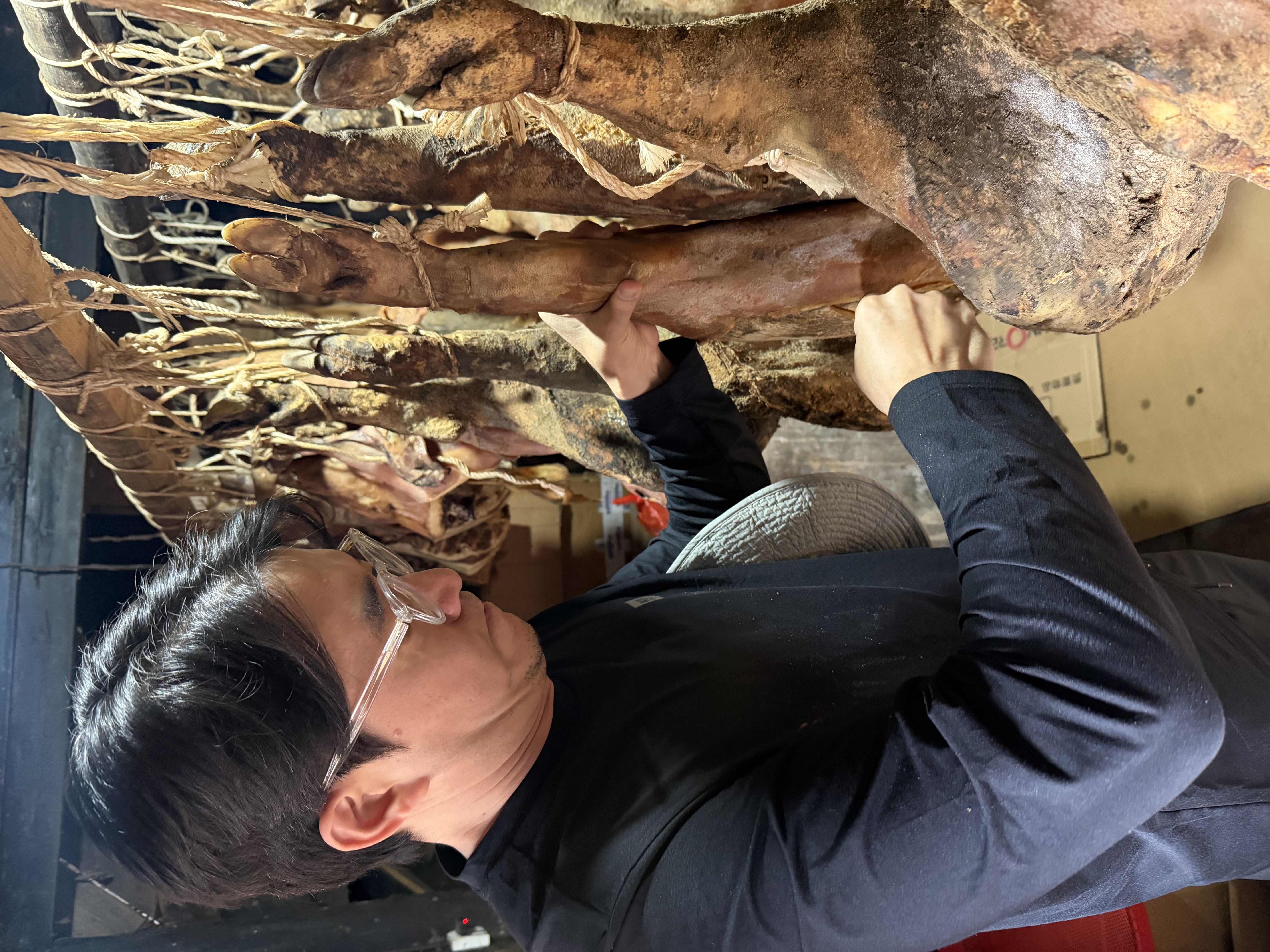
Nuodeng village is not large. But finding the right ham farmer takes time. This is not something you can solve with an app. You walk the entire village, house by house, judge by nose, press by finger, read by colour — and then you decide.
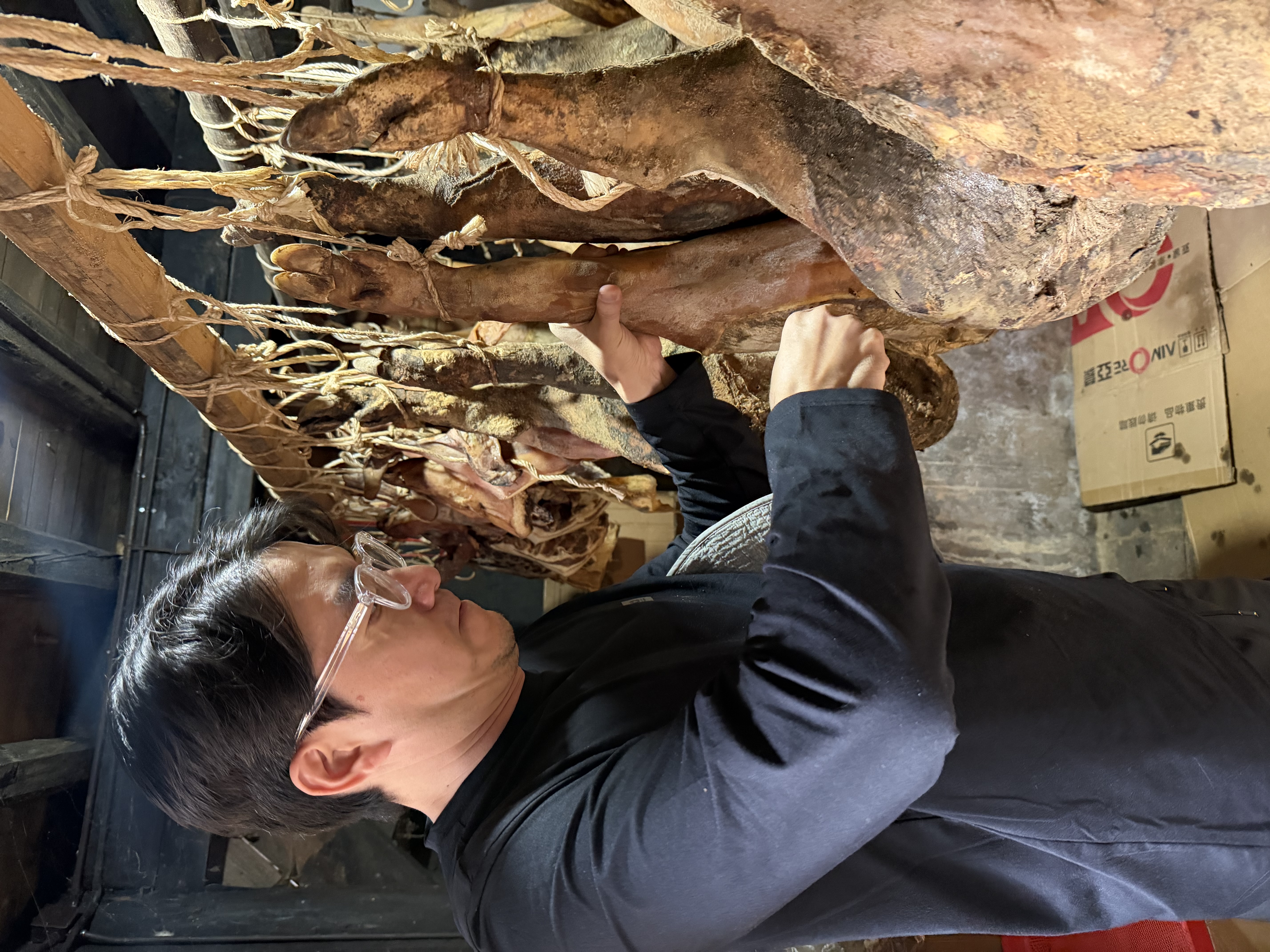
I spent the better part of a day doing this. At each house, I asked to see the hams. Most people were happy to show them — this is their pride. But pride is not the same as quality. Some hams looked right but smelled stale up close; others were too dark, aged too fast, suggesting problems with temperature or salt control. The selection process, stripped of romance, is a search for a specific character: clean, deep, mineral, with that thread of nuttiness I have only found in the best examples.
A Nuodeng ham aged for thirty-six months is not just preserved pork. It is a complex microbial ecosystem — a community of moulds, bacteria, and yeasts that have been doing slow, invisible work for three years. The same families of organisms found in Parma aging rooms and Ibérico cellars are present here: Penicillium moulds on the surface, Lactobacillus strains within the meat, Staphylococcus species that develop the characteristic flavour compounds. But the specific strains are local — they evolved in this altitude, this humidity, this cellar air. Move them to a factory and you lose what makes them what they are.
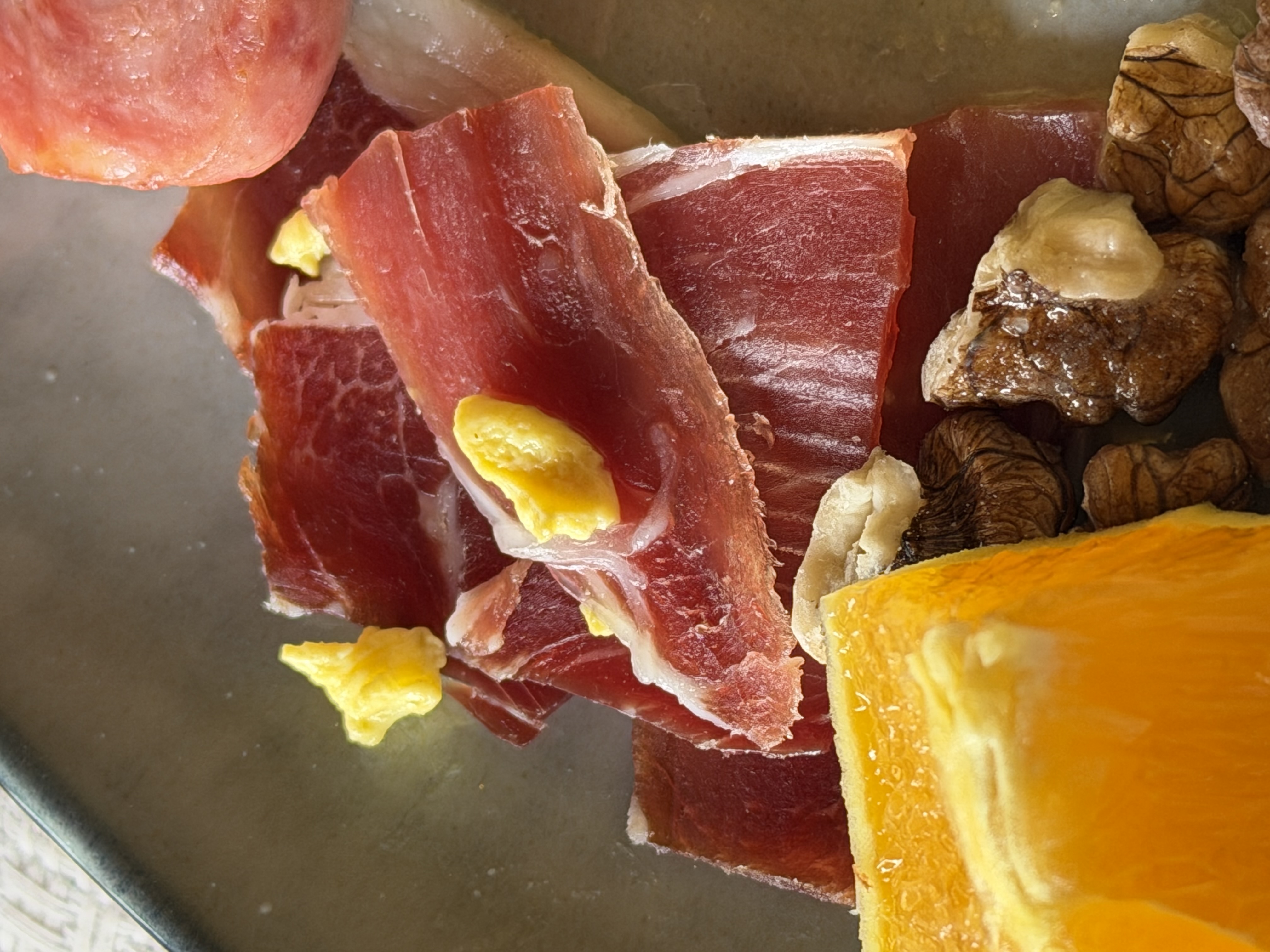
I asked several people in the village: what do the pigs eat? The answer reminded me of a famous comparison. Spanish jamón ibérico is considered among the world's finest hams partly because Iberian black pigs roam freely in cork oak forests eating acorns — that oil-rich nut that gives the ham its characteristic flavour structure. What do the Nuodeng pigs eat? Walnuts. The Dali region produces walnuts in abundance. Farm pigs are fed walnut fragments, walnut shells, and household kitchen waste. The fatty acid composition of walnut oil differs from acorn oil. When it suffuses the pork over years of aging, it produces a flavour base unlike any Spanish ham.
This is not a claim that Nuodeng ham is better than jamón ibérico, or vice versa. It is a claim that they are different things — from different lands, different plants, different animals. Flavour never arrives from a vacuum.
We eventually settled on one family — a Bai minority auntie whose stock was not large, but each leg was right. She brought us to the kitchen and had us eat lunch with the workers. On the table: spring wild vegetables picked from the mountain, some stir-fried, some eaten raw. One leaf, she said, was what the salt road farmers used to chew as they walked — in the mouth, it was cool and mint-adjacent but not quite mint, with a green edge, and after a few chews it became something like chewing gum. I ate several leaves. Hwan photographed them.
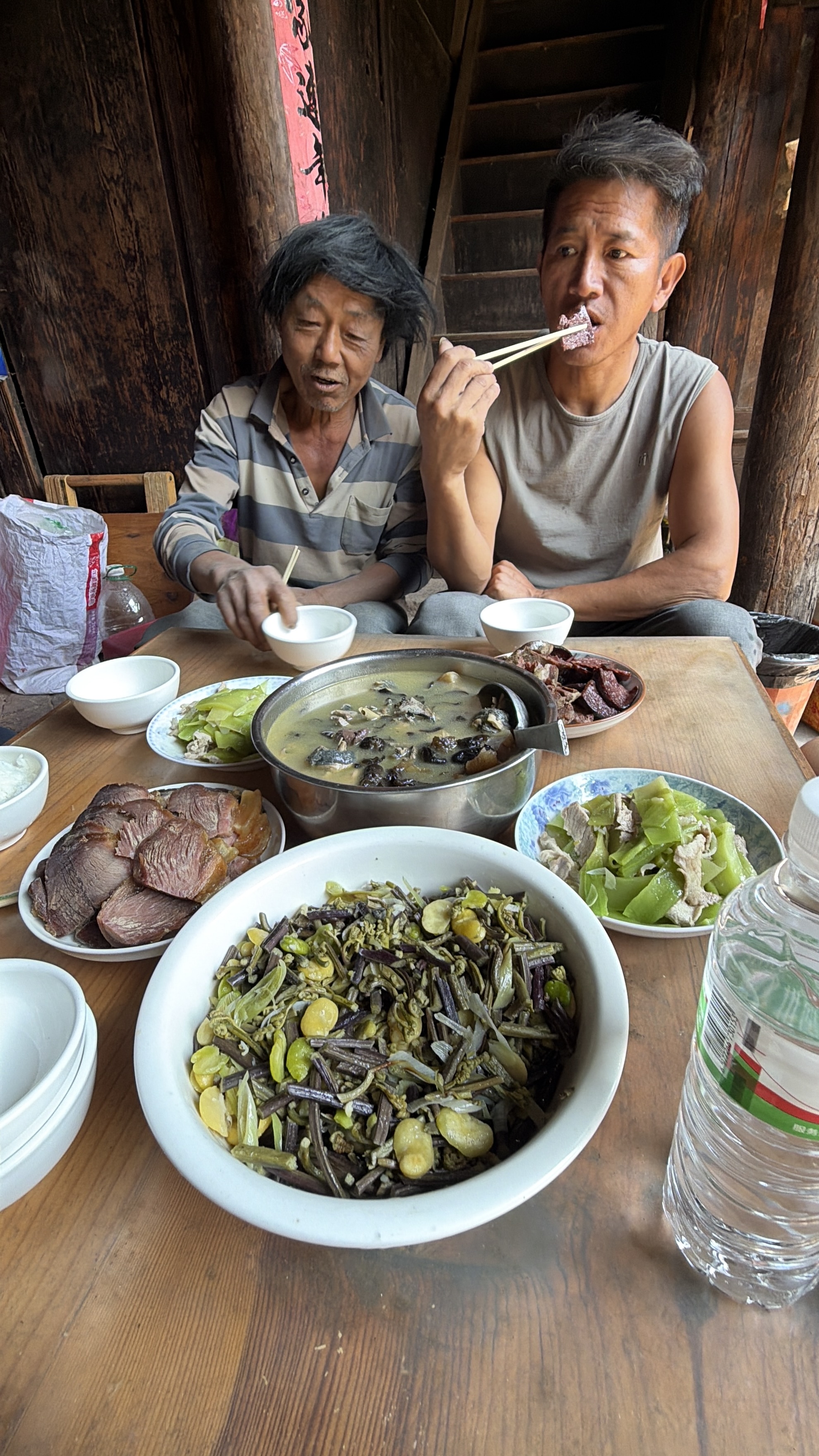
What was on that table was not complicated, but extraordinarily diverse. Eight or more different plant species in a single meal — spring mountain vegetables that don't have names in English — represents a range of prebiotic fibres that feeds different bacterial species in the gut. Eating a wide variety of wild vegetables does far more for your gut microbiome than eating one vegetable repeatedly. The Bai farming families who eat like this every day, walking the hillside to their fields, getting sun, drinking mountain water — their gut microbiome would look nothing like ours. We didn't do a controlled study. But we didn't need to.
After lunch, we talked with the auntie about the sanitation improvement project GutCommon is currently developing. We have been doing this work together with a young Bai woman — we call her 妹妹, little sister — who speaks Mandarin, Cantonese, and understands how the village actually operates. The conversation covered: standardised vacuum-packing procedures, storage temperatures, choice of packaging materials. She had every detail memorised and was frank about the reality: many of the farming households here have limited equipment, and change takes time.
That evening the conversation ran late. Eventually Hwan and I said we needed to leave — a long road ahead, an early start. She nodded and told us to rest.
At 1am, my phone vibrated. A message from her: the ham is ready, come get it before you go. We went downstairs to find her in the kitchen light, freshly sliced ham vacuum-sealed and arranged neatly on the table. She said: it's a long road, take this for the journey. Nothing more — just helped us pack the ham into our bags, and waved us off.
She stayed up until 1am cutting and vacuum-sealing the ham. We had a long road ahead. She knew that.
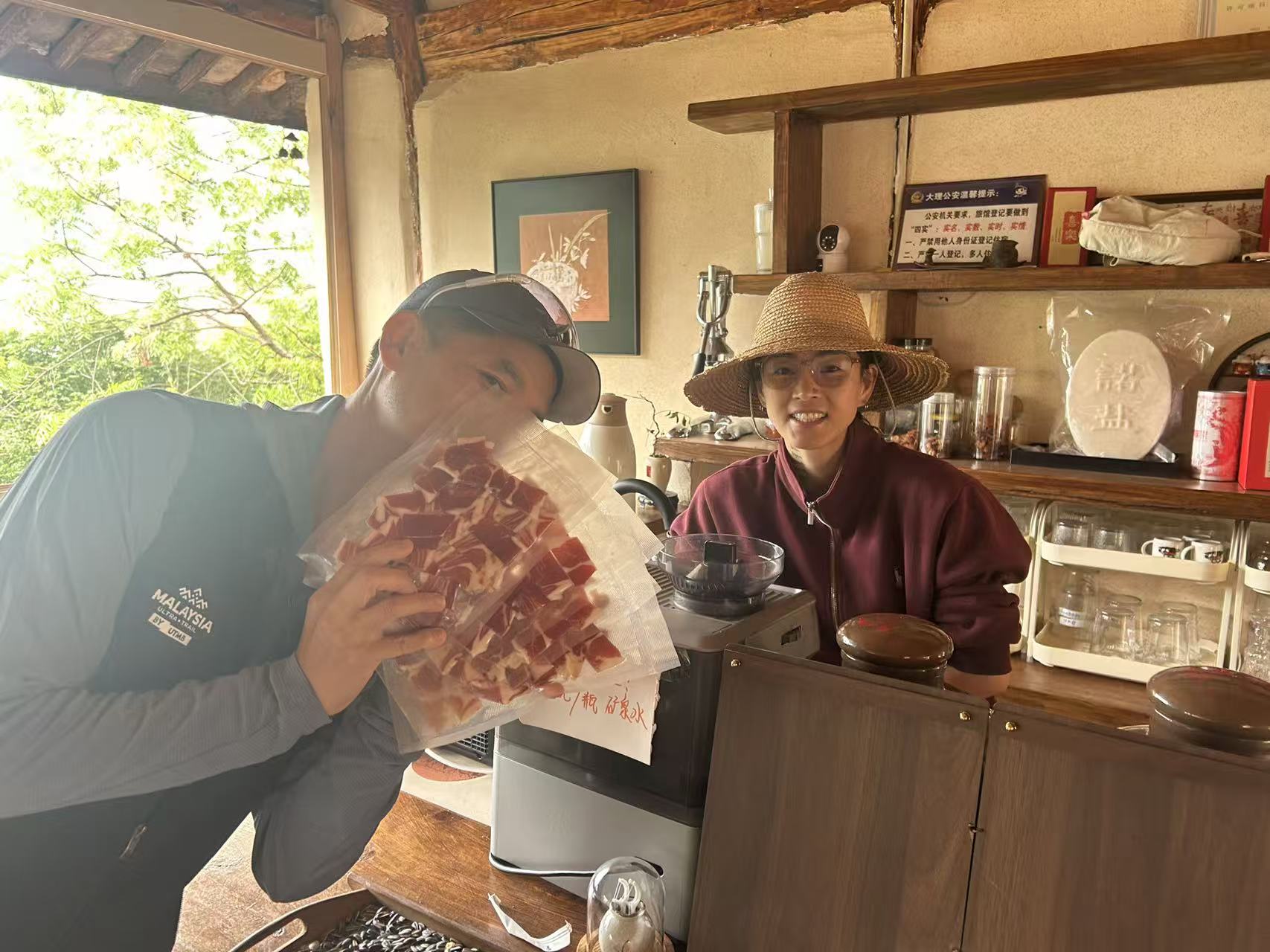
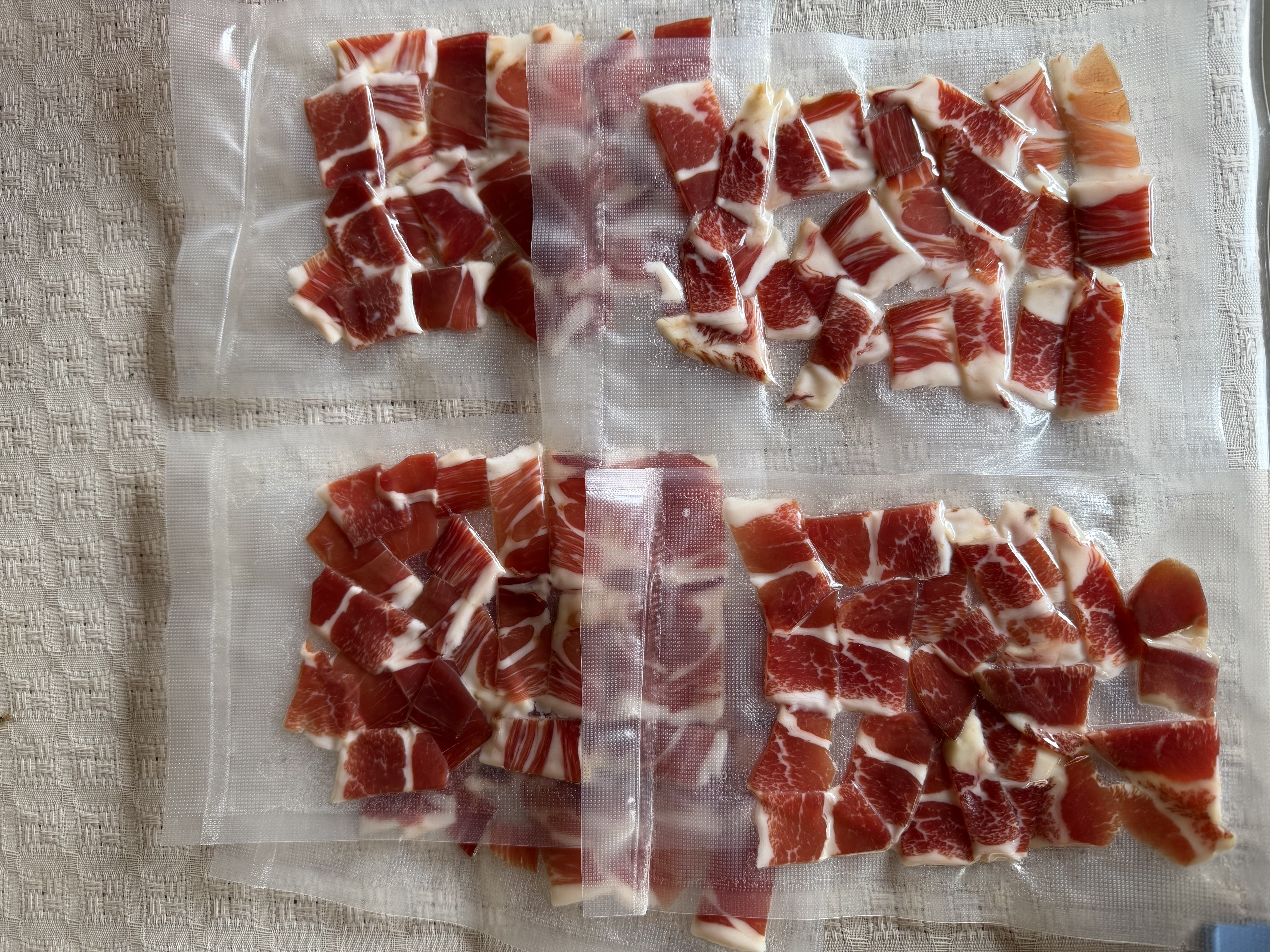
Hwan later said this was the best Nuodeng ham he had ever tasted. He delivered this verdict with full sincerity: "Certified by handsome Obba." I did not disagree.
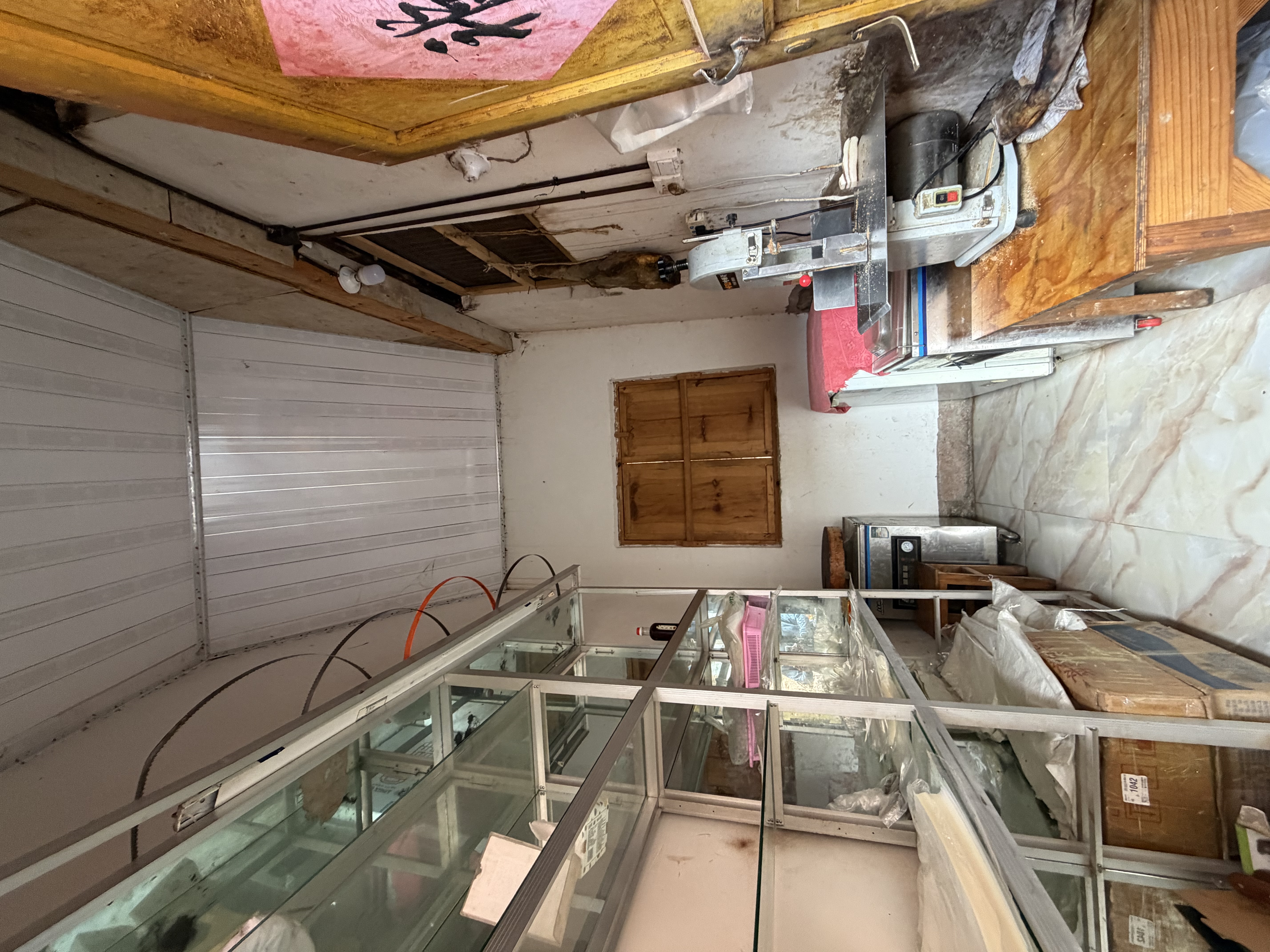
This is the story behind GutCommon's sourcing standard — not a specification sheet, but a kitchen still lit at 1am, and a person who knew how far we had to go. We believe supporting these producers is the most practical form of protection for this place — not photography, not travel writing, but consistent purchasing that gives this craft a reason to continue. To learn more about the ham we bring back, visit our ham page.