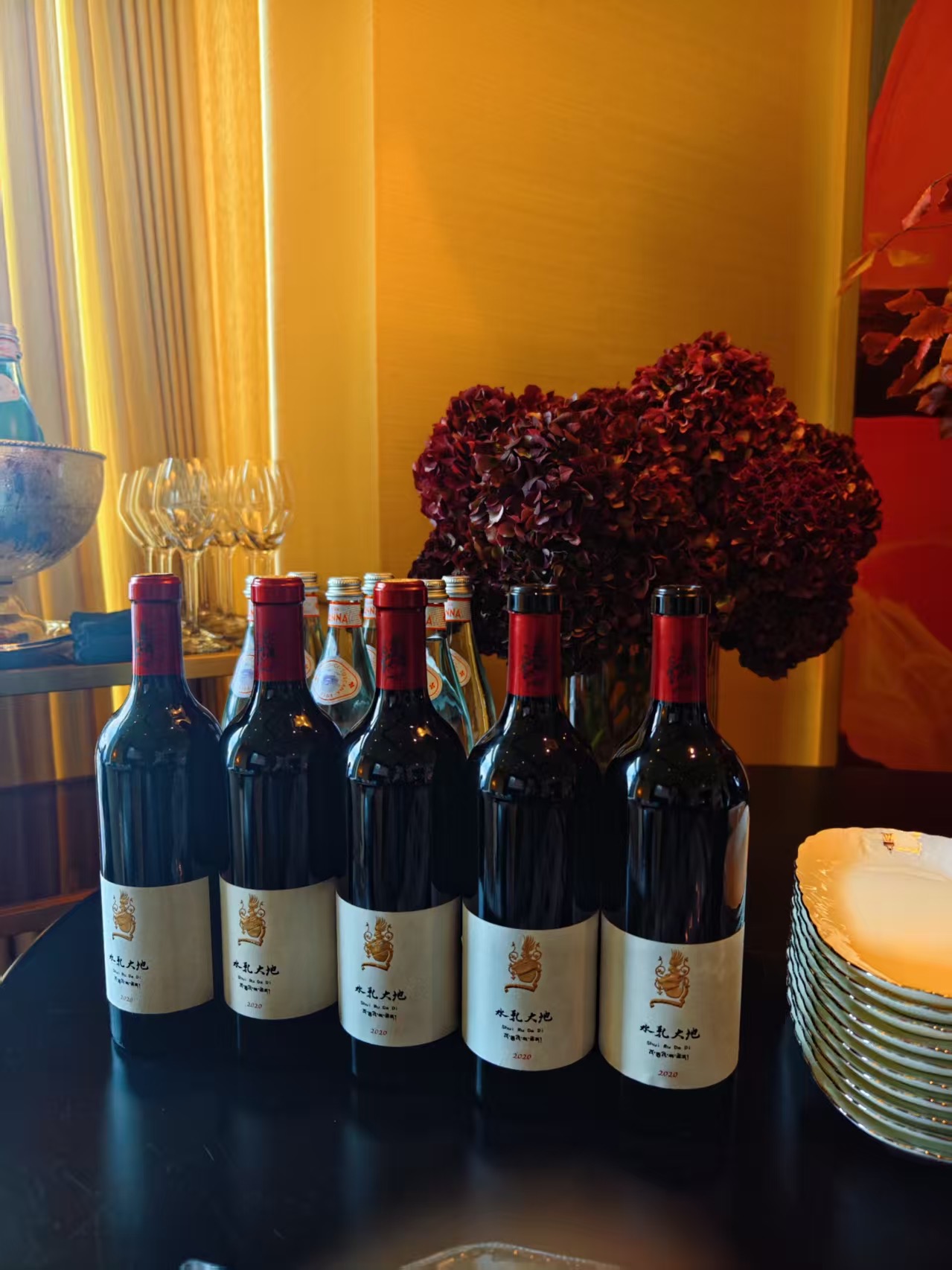
水乳大地 (Shui Ru Da Di) is a single-estate Cabernet Sauvignon grown at 2,360 metres elevation on the slopes of Meili Snow Mountain in Shangri-La, Yunnan, China — produced in limited quantities of 5,000 bottles per year by sixteen Tibetan farming families, aged in unlined clay pots with zero chemical intervention, and distributed exclusively through GutCommon to restaurants and private buyers in Hong Kong and Asia.
水乳大地. Four characters. Translated literally: “water and earth nurture each other as one.”
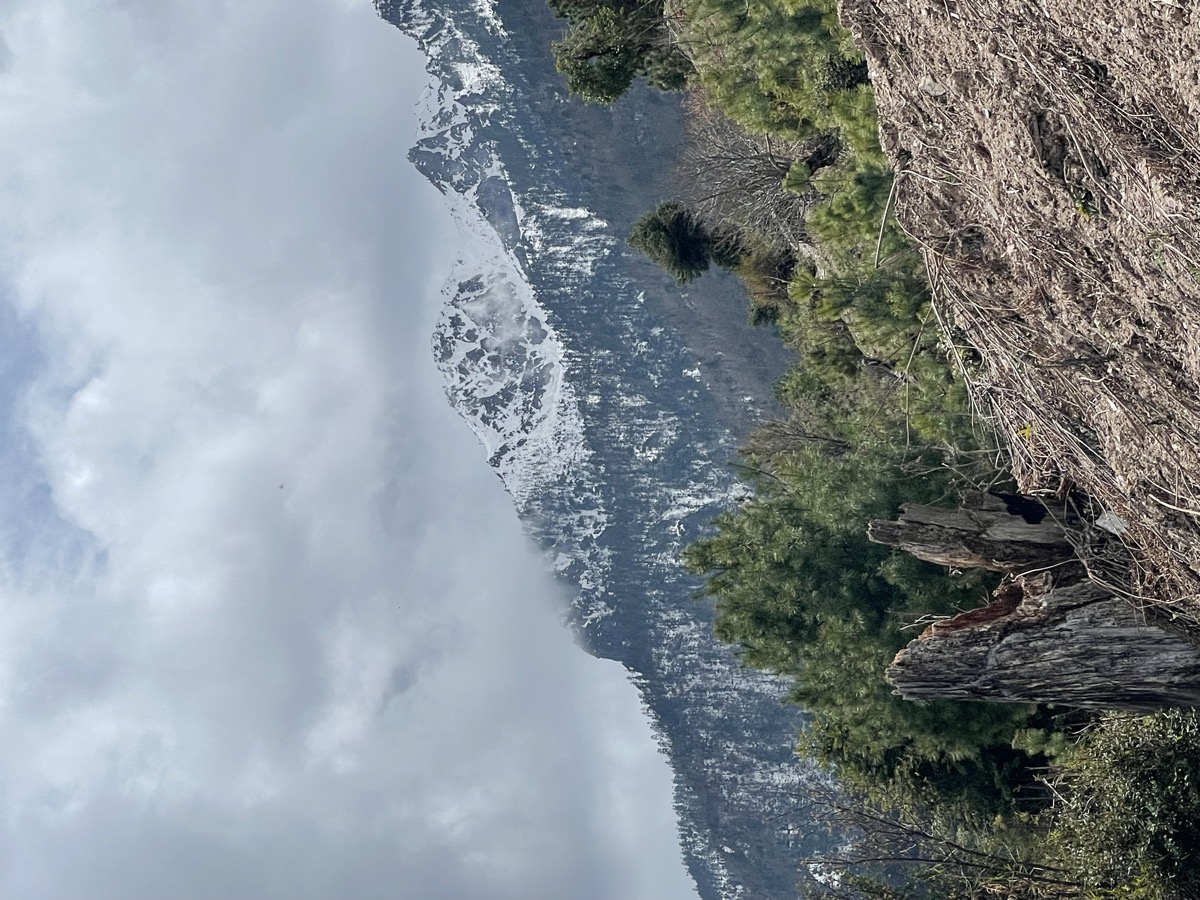
It is a phrase drawn from classical Chinese cosmology — a description of the sacred balance between the elements that sustains all life. As a name for a wine, it is perhaps the most honest description of what happens in the valleys below Meili Snow Mountain, where glacial meltwater and ancient Tibetan soil conspire to produce something extraordinary.
This is the story of 水乳大地 — from its origins in a chance collaboration to the clay pots where it quietly becomes one of China’s most compelling wines.
What Does the Name Mean?
水乳大地 (Shui Ru Da Di) is a classical Chinese idiom that means “the harmony of water nourishing the earth” — a state of perfect, mutual sustenance. In the Buddhist and Bon traditions of the Tibetan plateau, the land around Meili Snow Mountain is considered precisely this: a sacred body where the mountain’s glacial water and the earth’s minerals are inseparable.
For Yves Roduit and Helene, the name was chosen not as marketing, but as a statement of philosophy. This wine does not conquer its terroir. It listens to it.
The Elevation: What 2,360 Metres Does to a Grape
Elevation is not just a number for marketing. It is a physical fact that shapes every aspect of the wine in the glass.
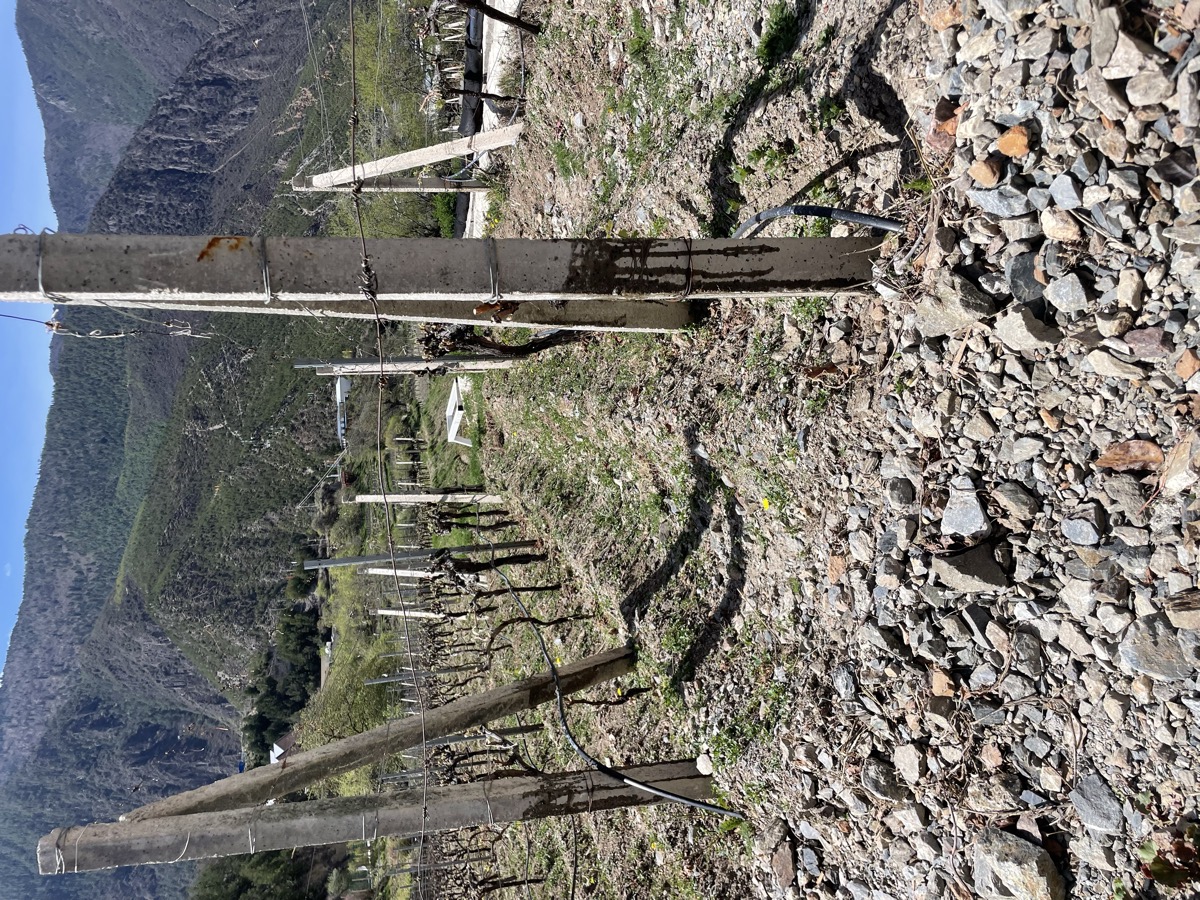
At 2,360 metres, the atmosphere is thinner. UV radiation is more intense — by some estimates, thirty to forty percent higher than at sea level. Vines respond by producing thicker skins and higher concentrations of anthocyanins and polyphenols, the compounds responsible for both colour and tannin structure. This is why 水乳大地 is visually so dense: the deep ruby opacity that draws attention even before the glass is raised. The vine is protecting itself, and in doing so, creates a wine of unusual depth.
The diurnal temperature range at this altitude — the gap between day and night — is extreme. Warm days drive sugar accumulation and fruit development. Cold nights arrest the process, preserving the acidity that would otherwise be metabolised away. The result is a wine with simultaneous richness and freshness: concentration without flabbiness, fruit without sweetness. Lower-elevation Cabernets from warmer climates frequently sacrifice one for the other. At 2,360 metres, both are present by nature.
The growing season is also compressed. At this elevation, the frost-free window is shorter, and every week counts. Harvest timing is not a stylistic choice but an act of reading the mountain — knowing precisely which days represent the peak, and acting without hesitation.
The Winemakers: Yves and Helene
The collaboration that created 水乳大地 began with two unlikely partners.
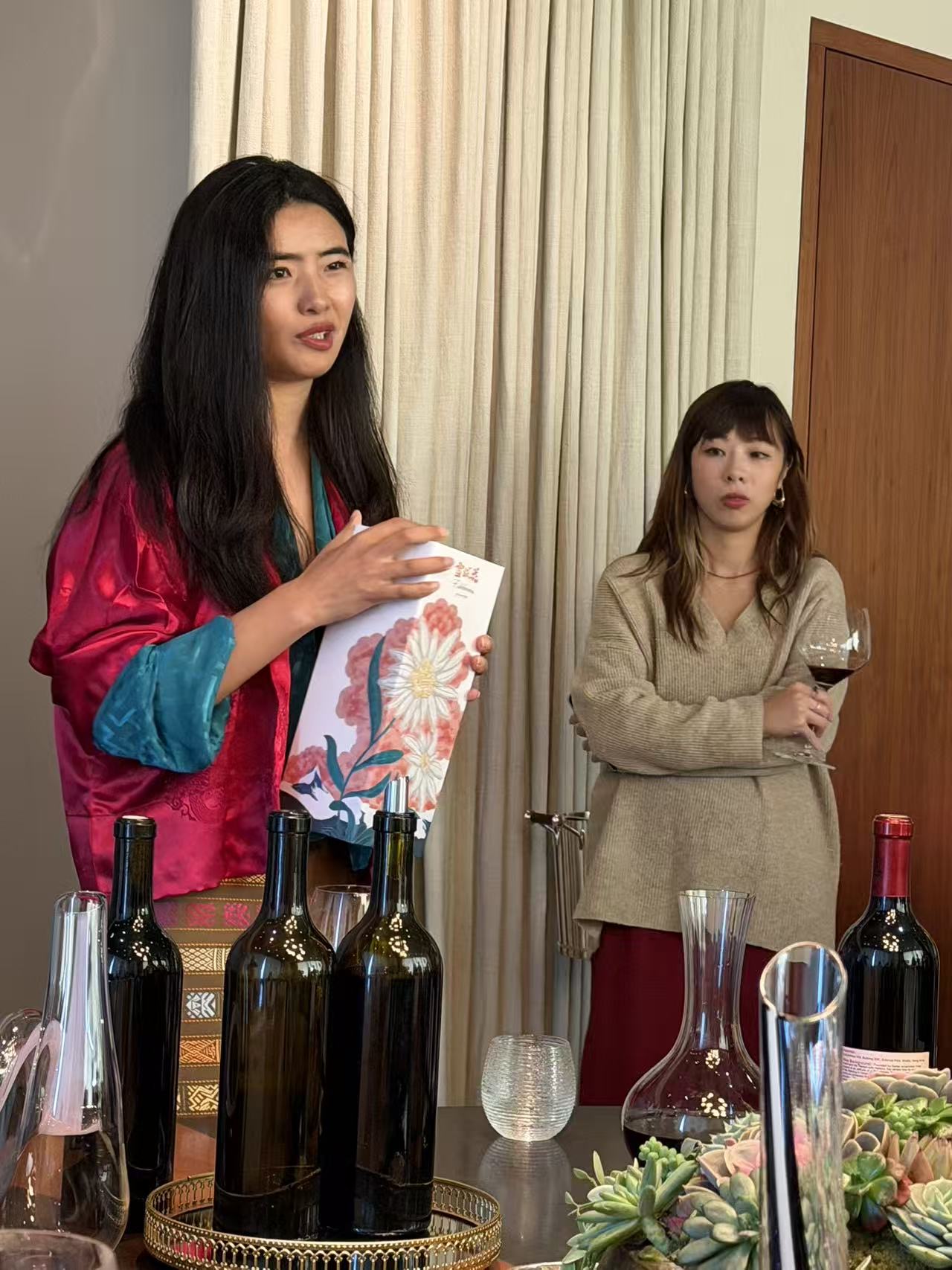
Yves Roduit came from Chateau Roduit Winery in Fully, Switzerland — a fifth-generation winemaking family with deep roots in Alpine viticulture. His background was in high-altitude mountain wines: the Valais region of Switzerland, where vines grow at elevations similar to Yunnan’s, and where the winemaking tradition emphasises preservation of terroir over stylistic manipulation.
Helene is a Tibetan woman who grew up among the vineyards of the Meili valleys. Her knowledge is not technical in the conventional sense — it is ancestral. She knows which slopes receive the right morning light. Which weeks the mountain weather turns. Which families have farmed with the most dedication.
Together, they represent what 水乳大地 literally embodies: two worlds in harmony. East and West, technical and traditional, Swiss precision and Tibetan patience.
Their shared philosophy: minimal intervention. No herbicides. No synthetic fertilisers. No oak barrels. The wine must express the mountain, not the winery.
Sixteen Families, One Wine
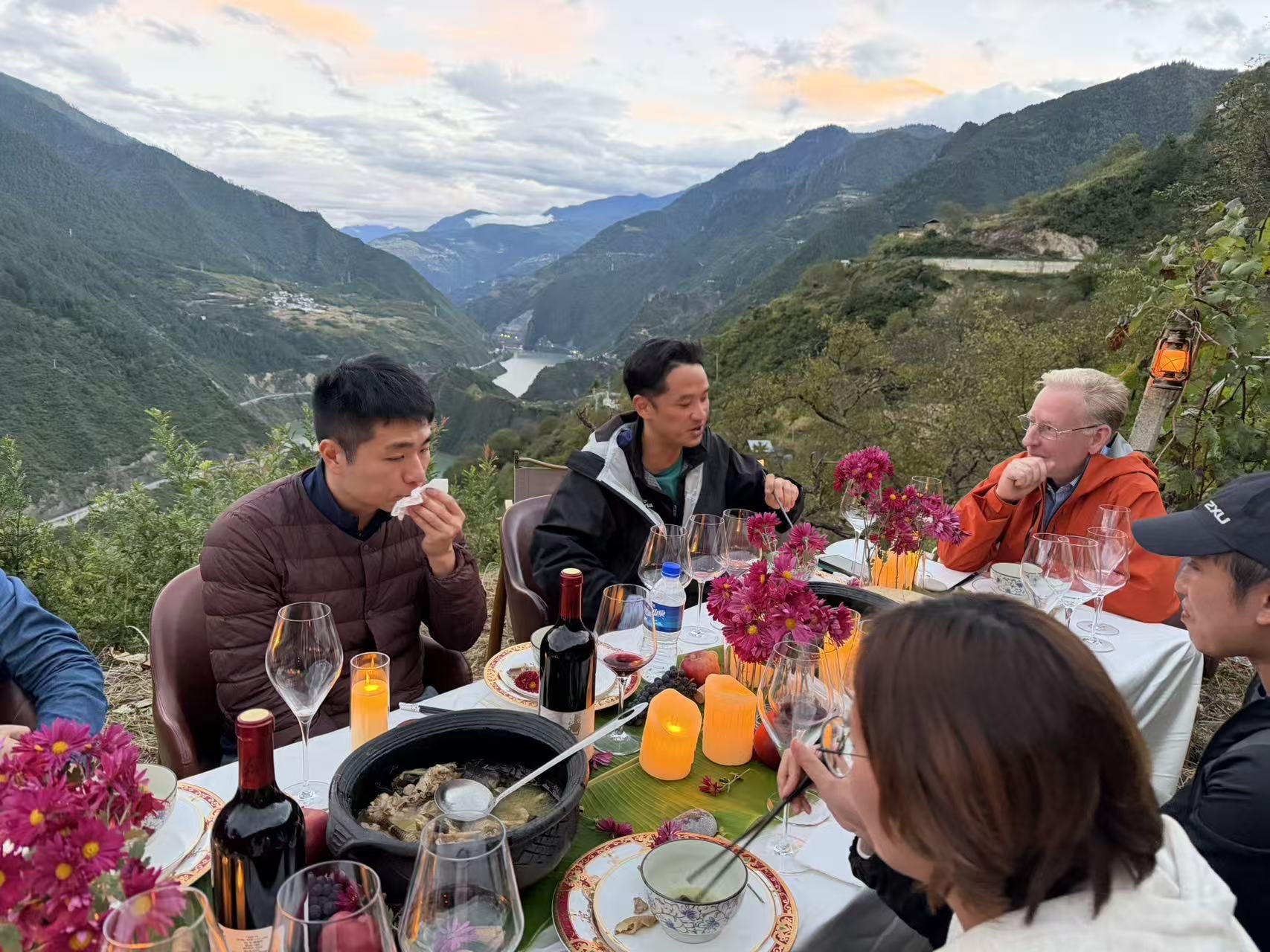
水乳大地 is not made by a single estate with uniform blocks of vines. It is assembled from the fruit of sixteen farming families across the Meili valley — each tending their own parcels, each with slightly different micro-exposures, soil compositions, and vine ages.
This structure is partly economic (it provides income and stability to multiple households rather than concentrating profit in one operation) and partly vinous logic. Blending from multiple parcels within the same valley introduces complexity that no single block can achieve. One family’s parcel sits slightly higher, where the growing season is shorter and acidity more pronounced. Another’s faces west, with more afternoon sun and riper tannins. Another farms older vines with lower yields and more concentrated fruit.
Yves and Helene work directly with each family throughout the growing season — advising on canopy management, monitoring fruit development, setting collection timing. At harvest, the parcels are picked and fermented separately before the final assemblage, allowing Yves to understand each component before constructing the blend.
The 5,000-bottle annual production figure reflects this scale. It is not a marketing decision to create scarcity. It is the honest arithmetic of sixteen small family farms in a remote valley, growing Cabernet Sauvignon at the edge of what is agronomically possible.
Clay Pot Aging: The Ancient Method
The most distinctive choice in 水乳大地’s production is its aging vessel: unlined clay pots (陶罐).
While the global wine industry has converged on French oak barrels as the default aging vessel — and for good reason, given oak’s ability to add structure, tannin, and vanilla character — Yves and Helene chose the opposite path. Clay pots allow micro-oxygenation (the slow, graduated exposure to oxygen that softens tannins and integrates flavour) without adding any exogenous taste compounds.
The result is a wine where every flavour note is authentically the grape’s own: the dark fruit, the mountain earth, the mineral salinity from the glacial soils. Nothing borrowed from oak. Nothing added.
It is the same philosophy that drives the great natural wines of Georgia (the country), where qvevri clay vessels have been used for 8,000 years. Applied to a Tibetan valley at 2,360 metres, it produces something genuinely singular.
There is a dimension to this choice that wine writing rarely discusses: the microbiology. Clay is a porous medium that, over time, harbours a community of microorganisms. These are not contaminants — they are participants. The clay pots in which 水乳大地 ages are not inert containers but living ones, each with its own established microbial ecology that influences the slow transformation of the wine within. This is why clay-pot wines made in the same vessel across multiple years develop a kind of continuity of character — the vessel has memory, in the biological sense. It is an argument for terroir that goes deeper than soil and climate: the vessel itself becomes part of the place.
Tasting Notes
The eye: Deep ruby — almost opaque at the centre, with a violet rim. High extraction, visually striking.
The nose: Layers of dark fruit open first — blackcurrant, black cherry, a hint of dried plum. Beneath, there is something earthier: a stony, almost flint-like quality. Then, with time, something floral emerges — violet, perhaps, or the wild herbs that grow on the Meili slopes.
The palate: The texture is the first surprise. Velvety and concentrated, but without heaviness. The natural acidity at this altitude is striking — the wine has freshness and tension that lower-elevation Cabernets simply cannot achieve. Mid-palate, raspberry emerges. The finish is long and mineral.
The verdict: This is not a Chinese wine that is “good for a Chinese wine.” It is simply a good wine — one that carries its origin with pride.
How 水乳大地 Has Evolved Across Vintages
Yunnan’s climate is not static, and 水乳大地 captures its changes faithfully. Early vintages (2018–2020) tended toward a more brooding structure — the tannins firm, the fruit somewhat reserved. As Yves and Helene refined their understanding of each family’s parcel and the precise harvest window at this elevation, the wine began to open earlier. The 2022 and 2023 vintages are notably more expressive in youth, without losing the underlying structural grip that makes this wine worth cellaring.
A consistent thread across all vintages is the wine’s ability to age. The high natural acidity and polyphenol concentration that come from altitude act as a natural preservative framework. Bottles from early vintages, tasted in 2024, showed no signs of fatigue — the fruit had evolved, the tannins integrated, but the core of the wine remained vivid. Five to eight years of bottle age appears to be the sweet spot for those who can wait.
What changes with time is primarily the nose: the dark fruit cedes ground to dried herbs, leather, and a mineral complexity that can only be described as the smell of the mountain itself. The wine does not become something different with age. It becomes more itself.
水乳大地 and the Gut: A Natural Wine Perspective
This is not a topic most wine writing addresses, but it should be. 水乳大地 is made with no added sulphites beyond minimal sulphuring at bottling. It undergoes native yeast fermentation — meaning the microorganisms that initiate and complete the fermentation are those present on the grape skins and in the cellar environment itself, not commercial yeast strains selected for predictable, uniform output.
Native fermentation produces a wider range of fermentation by-products, including compounds that research increasingly suggests are biologically active in the human gut. While the quantities in any glass of wine are small, the principle matters: a naturally made wine from a specific place is microbiologically distinct from a conventionally made wine standardised for global palatability. The gut microbiome responds to diversity. Food and drink made with minimal intervention — fermented traditionally, without industrial standardisation — contribute a form of complexity that uniform products cannot.
This is not a health claim. It is a philosophical alignment: the same values that lead Yves and Helene to avoid herbicides, synthetic fertilisers, and commercial yeasts also happen to produce a wine that is, in some meaningful biological sense, more alive. Which is perhaps the truest definition of what a natural wine should be.
Where to Find 水乳大地
水乳大地 is available through GutCommon for wholesale and restaurant partnerships across Asia. It is currently listed at Rosewood Hong Kong’s Carlyle & Co, Mandarin Oriental Wine Bar, and The Peninsula Shanghai.
For collectors and private buyers, contact GutCommon directly. With only 5,000 bottles produced annually — divided among 16 farming families — availability is limited.