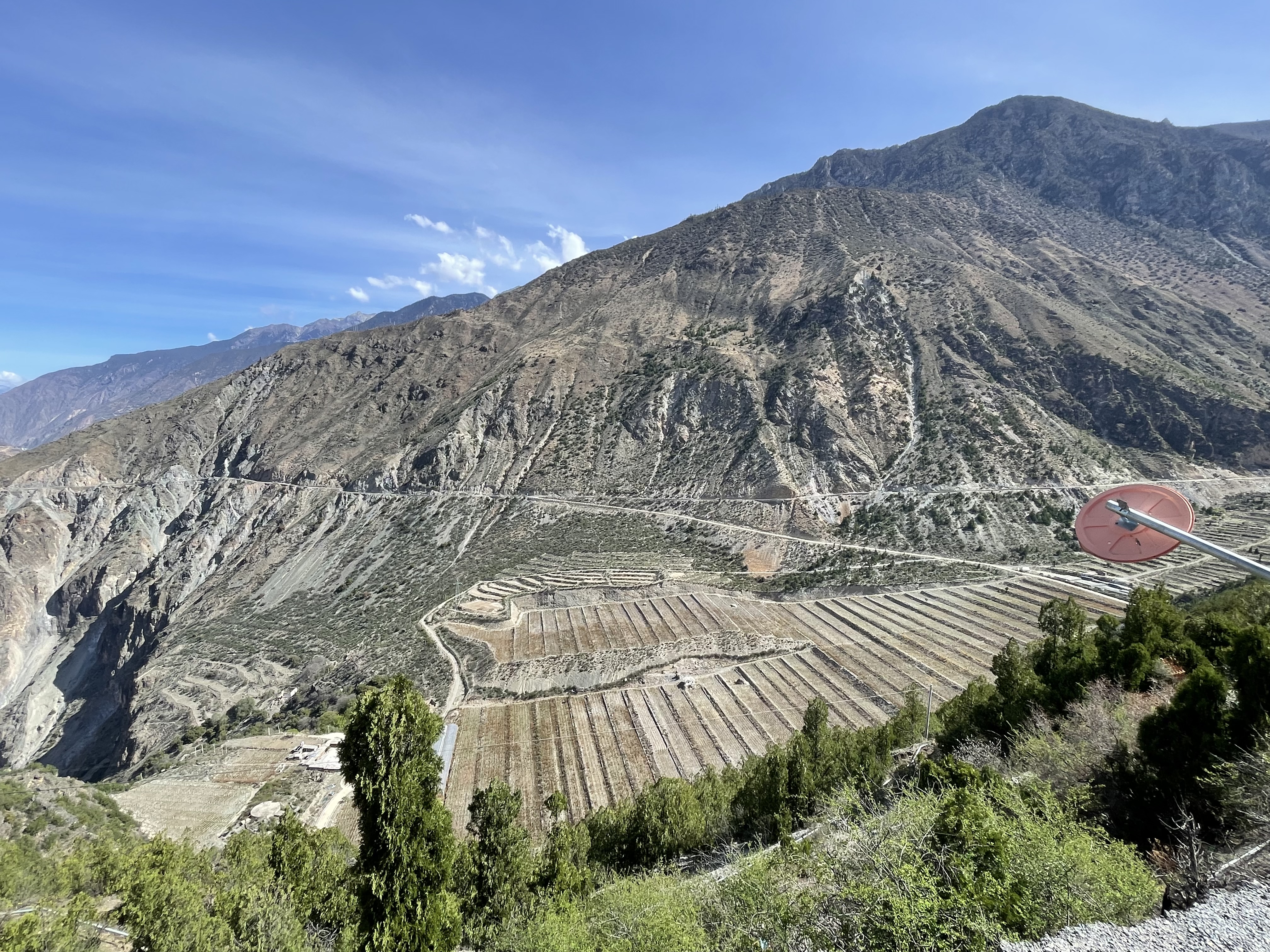
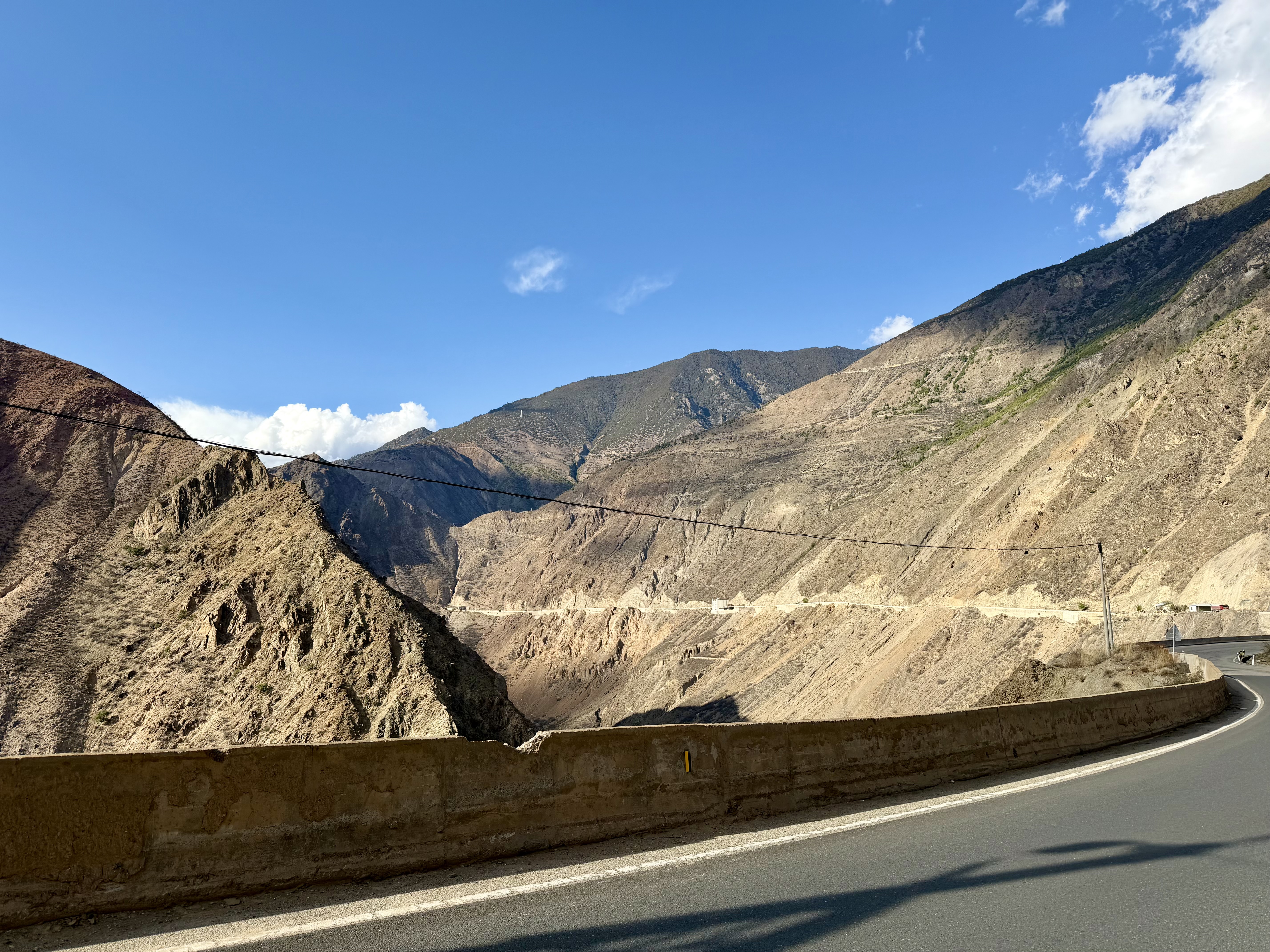
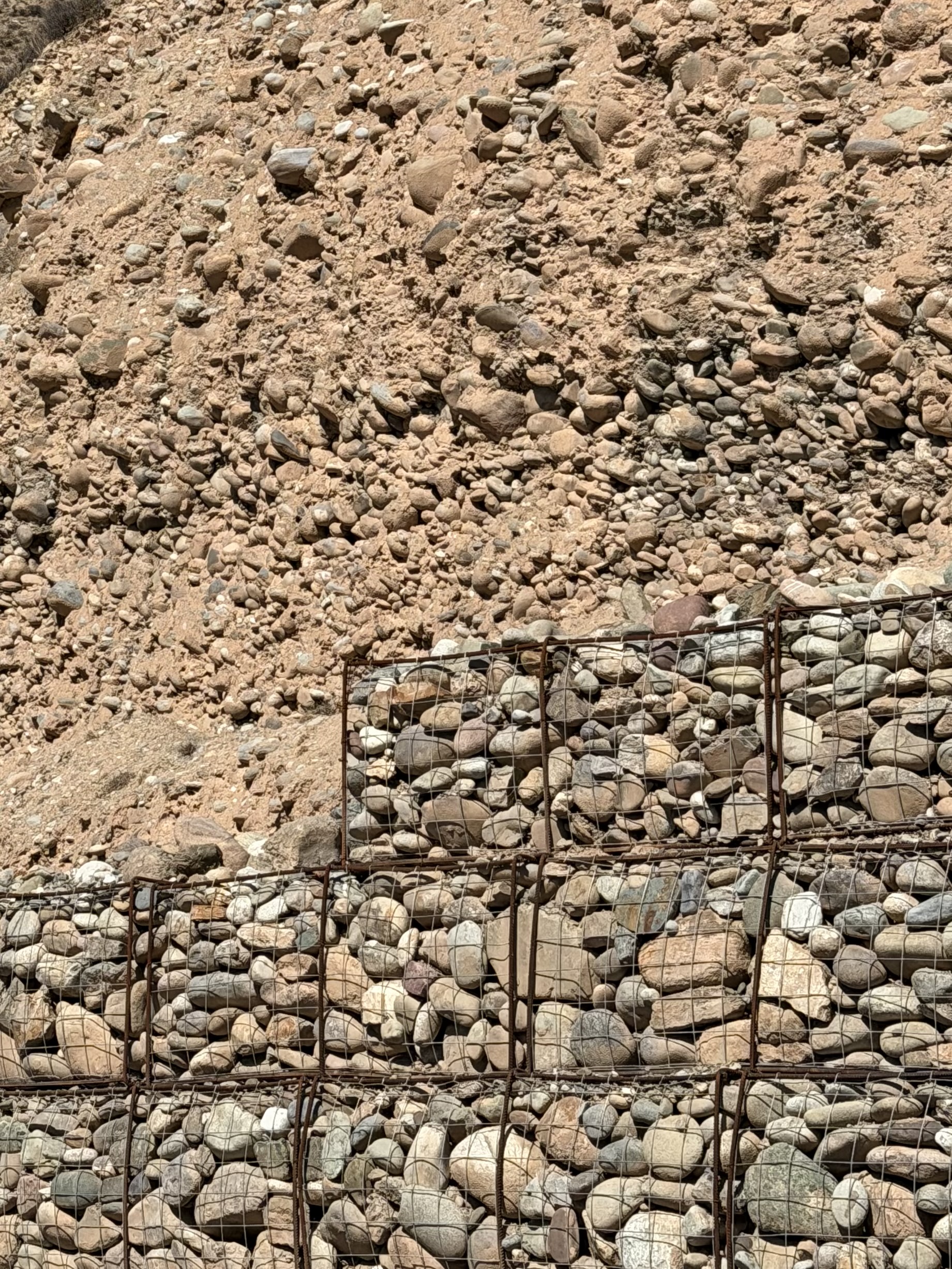
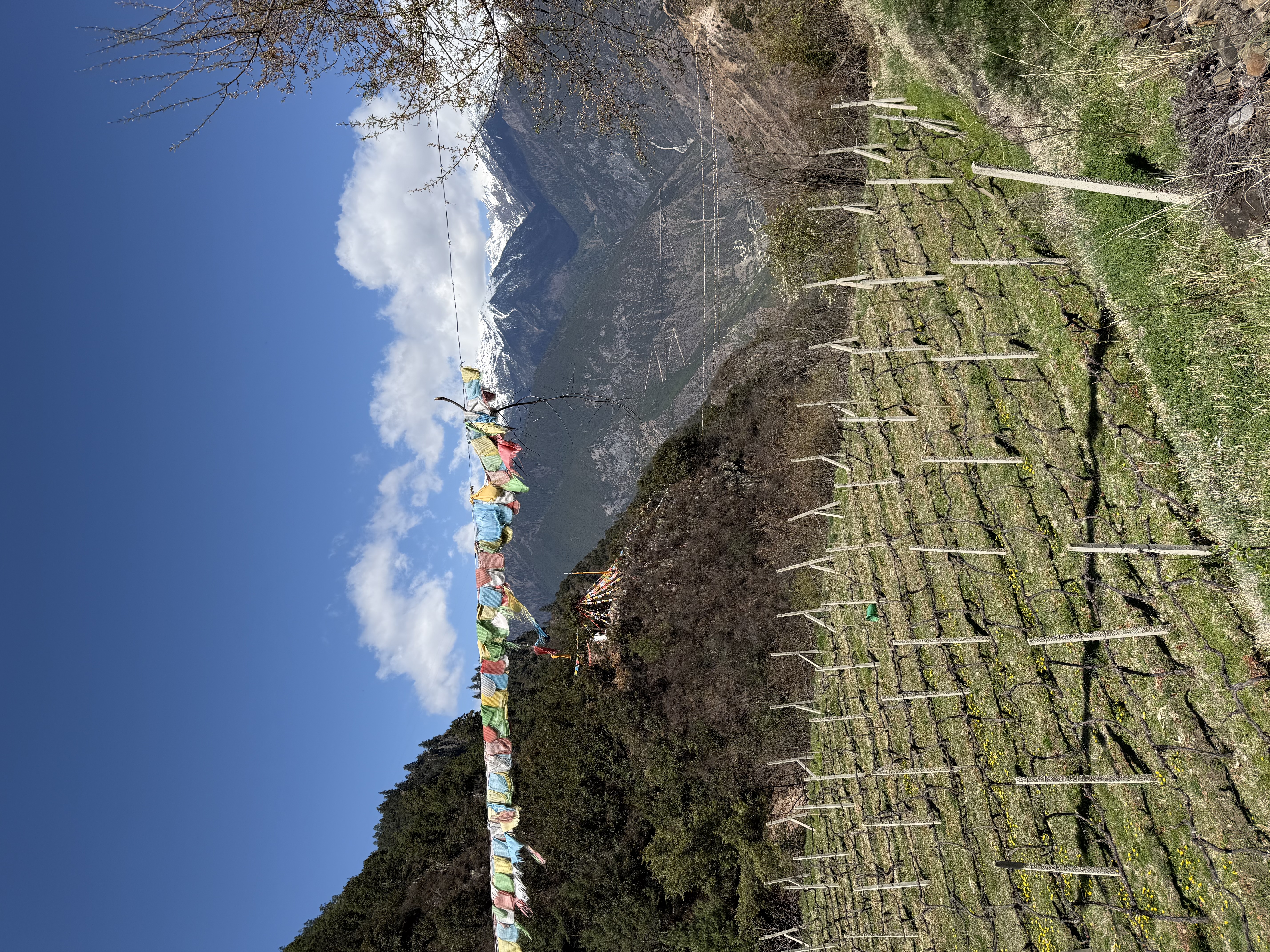
Looking up from the road along the Lancang River gorge, the vineyard hides in a fold of the terrain. You have to stop at the right angle to see the wooden vine stakes emerging from the slope — a human order imposed on ground that had no intention of being farmed easily. Below the road: the canyon. On either side: near-vertical scree slopes. Between the slope and the vineyard: rows of wire cages packed with rounded cobblestones — gabion retaining walls.
The first time I saw these gabion walls, I assumed they were standard roadside erosion control — not unusual in the Hengduan Mountains, where rockfall, mudslides, and slope erosion are routine engineering problems. But these walls are not protecting the road. They are protecting the mountain from itself: preventing the scree slope from continuing its slow collapse with every rainstorm, keeping the alluvial material on those hundreds of metres of gradient from carrying the vineyard below along with it. The reason these gabion walls exist is the same reason as the cost of growing a vine here.
土壤是什麼:沖積物、頁岩與石灰岩
The rounded cobblestones packed into the gabion cages are themselves a geological record. Their smoothness was made by water — not recent rain, but the ancient Lancang River at a much higher water level, thousands of years ago. This is an alluvial slope: layers of water-worn gravel, shale fragments, and thin limestone plates deposited by an ancient river system. Agronomically, this soil sits close to the definition of "poor": almost no organic matter, drainage so rapid it shows no mercy, roots forced to dig deep before they find anything worth absorbing.
This poverty is exactly what winemakers dream of.
Vines in comfortable soil spend their energy on leaves and shoots — yield goes up, concentration comes down. Force a vine into poor ground, and it redirects everything into the small amount of fruit it manages to set. Each bunch of grapes becomes the distillation of a vine's struggle in difficult conditions. This is the same logic as Burgundy's limestone slopes, Bordeaux's gravel banks, and this alluvial scree field below Meili Snow Mountain: impoverished soil produces wine with depth.
海拔做了什麼:紫外線、溫差與葡萄皮
This vineyard sits at roughly 2,200 to 2,600 metres elevation. On the global wine map, almost nothing else occupies this range — Argentina's highest Malbec vineyards reach 2,300 metres; most of Europe's top regions sit between 400 and 600 metres. At this altitude, the atmosphere is thin and UV radiation is thirty to forty percent stronger than at sea level. The vine's response is to develop thicker skin as a protective barrier.
Thick skin, in winemaking terms, means higher concentrations of anthocyanins (the source of colour) and polyphenols (the source of tannin). This is why wine from the Meili Snow Mountain region tends to appear almost opaque in the glass — a deep ruby that is nearly impenetrable at the centre. This is not the result of a winemaker's intervention. It is the direct imprint of sunlight on the skin of a fruit that had to defend itself.
A second physical reality of high altitude: diurnal temperature range. During the growing season, daytime temperatures reach 25–30°C, falling to 8–12°C at night. This gap determines the wine's structural skeleton. Warm days drive sugar accumulation and fruit development; cold nights slow the vine's metabolism and lock in acidity — the malic acid that would be metabolised away in warmer climates is preserved here. The result is a wine of simultaneous richness and tension: concentrated without being heavy, powerful without being blunt.
石籠牆說了什麼:掙扎是頂級風味的條件
Back to the gabion walls. They are not merely engineering structures — they are a place's way of telling you how difficult it is to work. Growing vines on a slope of more than 35 degrees, fighting erosion after every rainstorm, keeping vines alive through winters at an elevation where frost damage is a realistic threat each year — these are the reasons the gabion walls exist, and they are the same reasons the wine grown here is not ordinary.
In wine, there is a counterintuitive rule: the more difficult the agriculture, the more distinctive the wine. Burgundy's most celebrated Grand Cru vineyards are almost all its most demanding slopes; Bordeaux's most expensive plots are underlain by gravel that makes the summer heat merciless. The Meili Snow Mountain area stacks agricultural difficulty to a rare degree: impoverished soil, extreme elevation, steep gradient, compressed growing season. What those four difficulties imprint on the fruit is the concentrated, mineral, layered red liquid that ends up in the glass.
照片中這些用來防止水土流失的石籠牆,正體現了在這種險峻環境中種植葡萄的掙扎——而這種掙扎,往往就是頂級葡萄酒靈魂的來源。
在杯中:這種風土的味道
A Cabernet Sauvignon or Cabernet Franc from the Meili Snow Mountain area speaks first through colour. An almost opaque deep ruby, with a violet rim — the visual signature of high-altitude, thick-skinned fruit.
On the nose, the first seconds bring layered dark fruit — blackcurrant, black cherry, a whisper of dried plum. As the wine opens in the glass, deeper registers emerge: tobacco, dried herbs, something almost like crushed rock, sometimes a cedar or sandalwood underpinning. These aromas are not contributions from oak. They are the product of alluvial soil at altitude, intense UV exposure, and slow-accumulating ripeness working together.
On the palate, texture is the greatest surprise. Tannins are present and powerful but finely grained — force without roughness. This is the structural signature of high-altitude, thick-skinned grapes: high tannin quantity, low tannin aggressiveness, velvet rather than sandpaper. Acidity is pronounced, carrying a freshness and tension that keeps the wine light despite its concentration. The finish is long and mineral — graphite, some say; salt, others; or that sensation of biting into a cool, clean stone. This finish is what lower-elevation regions cannot replicate.
水乳大地:這片土壤上的一種答案
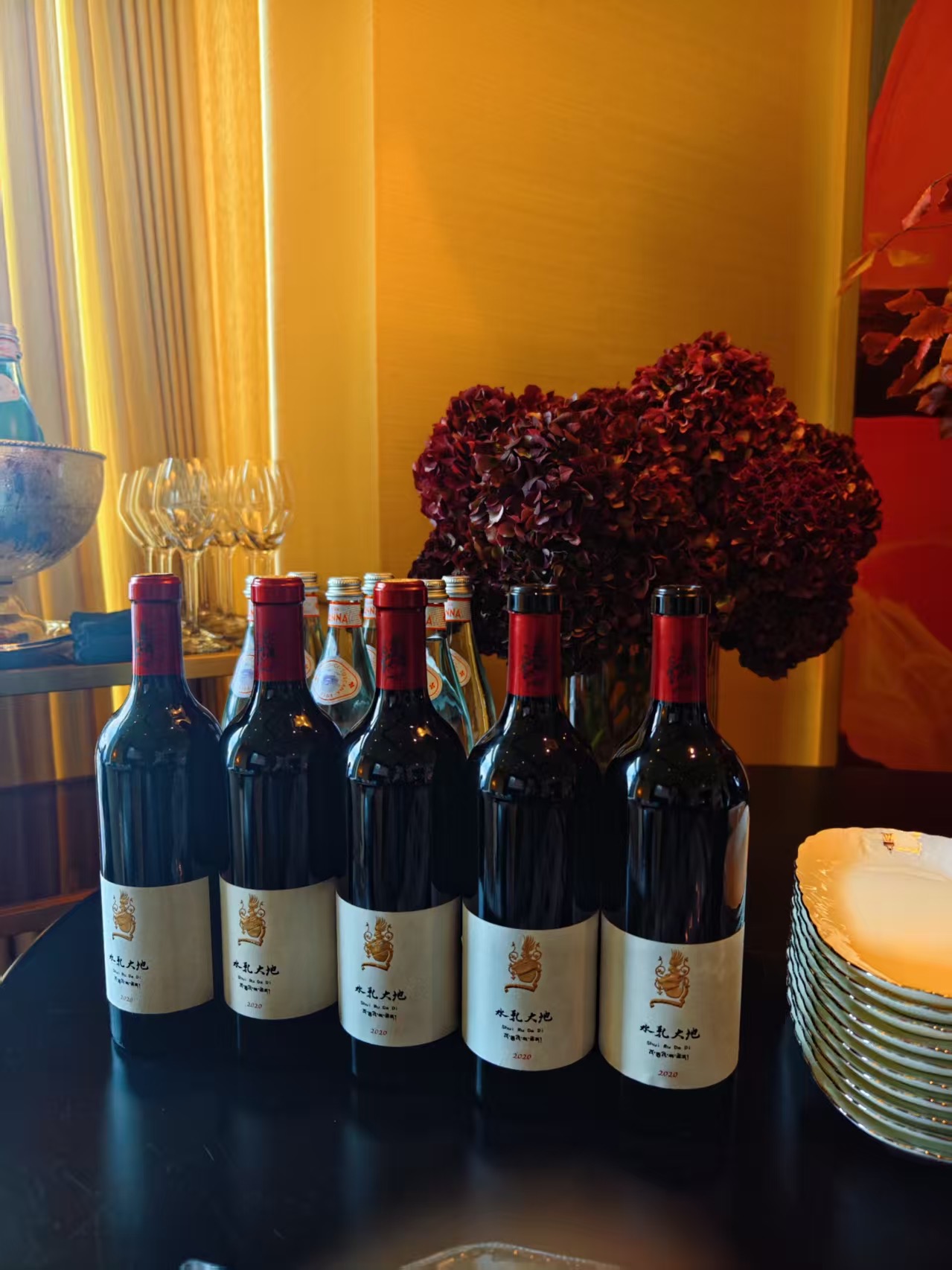
The best-known wine from the Meili Snow Mountain area internationally is Ao Yun, made by LVMH. But this region does not belong to a single label. 水乳大地 — the wine GutCommon represents — comes from the same valley: the same alluvial soil, the same elevation, the same diurnal temperature range. It is made by a Swiss winemaker and a Tibetan woman who grew up in this valley, aged in unlined clay pots, with no oak contribution at all.
Clay pot ageing, in this context, is not a gimmick — it is a philosophical extension. If the meaning of this soil lies in its specificity — its mineral memory, its microbial ecology, its high-altitude character — then placing the wine in oak barrels means adding a layer of external flavour over that specificity. Clay pots allow micro-oxygenation and tannin integration without adding anything that does not belong to this valley. Whatever minerals are in the cobblestones of those gabion walls, those are the minerals in the wine. This is an honest philosophy of winemaking: beginning from the soil, ending in the glass, nothing obscured in between.
To read the full story of 水乳大地, see our dedicated post. For the geographical context of Meili Snow Mountain terroir, see the Meili terroir guide. To enquire about the wine directly, visit our wine page.