Shangri-La old town, the day before the flight from Lijiang. This was the last stop, and an unexpectedly long one.
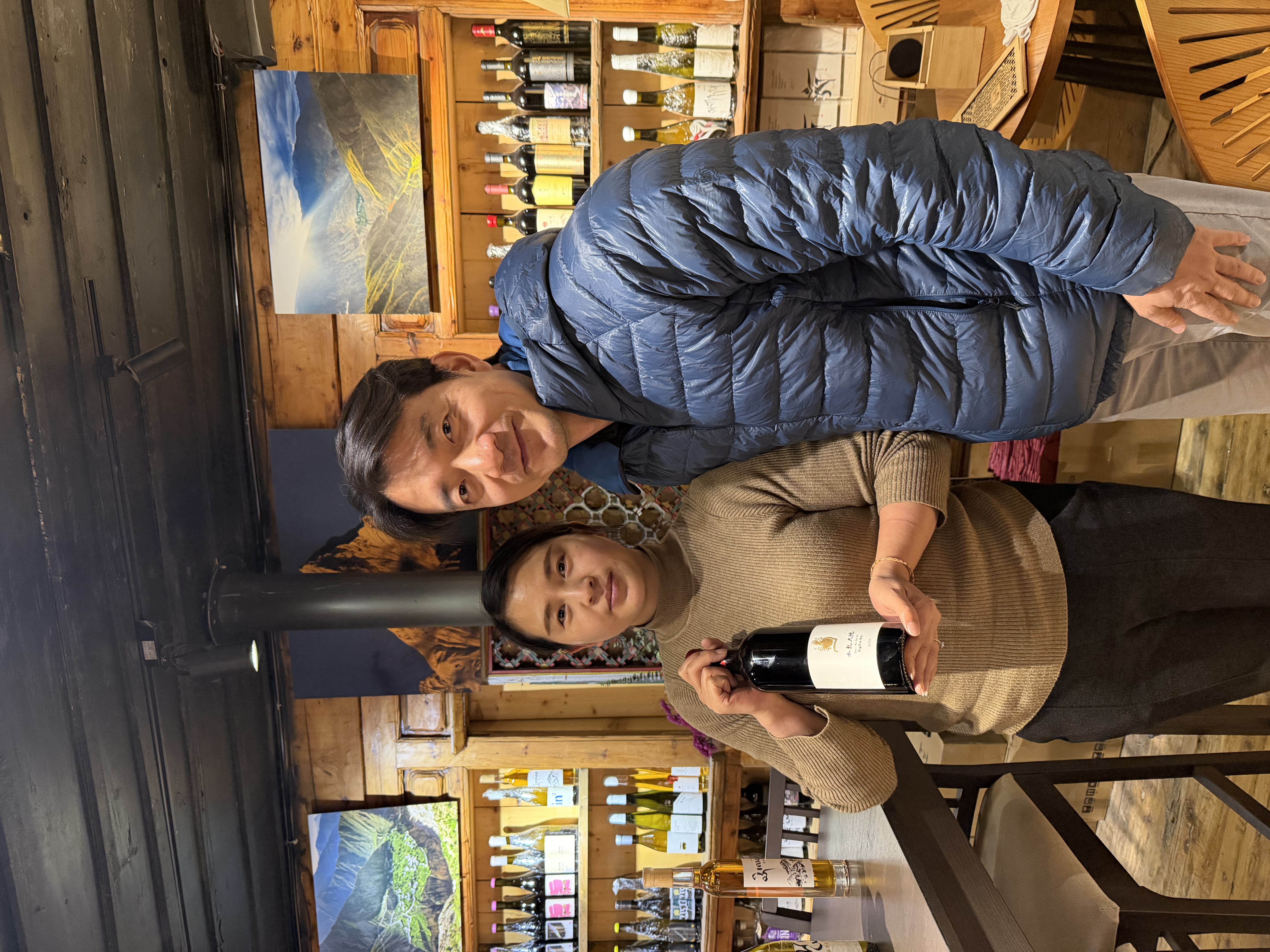
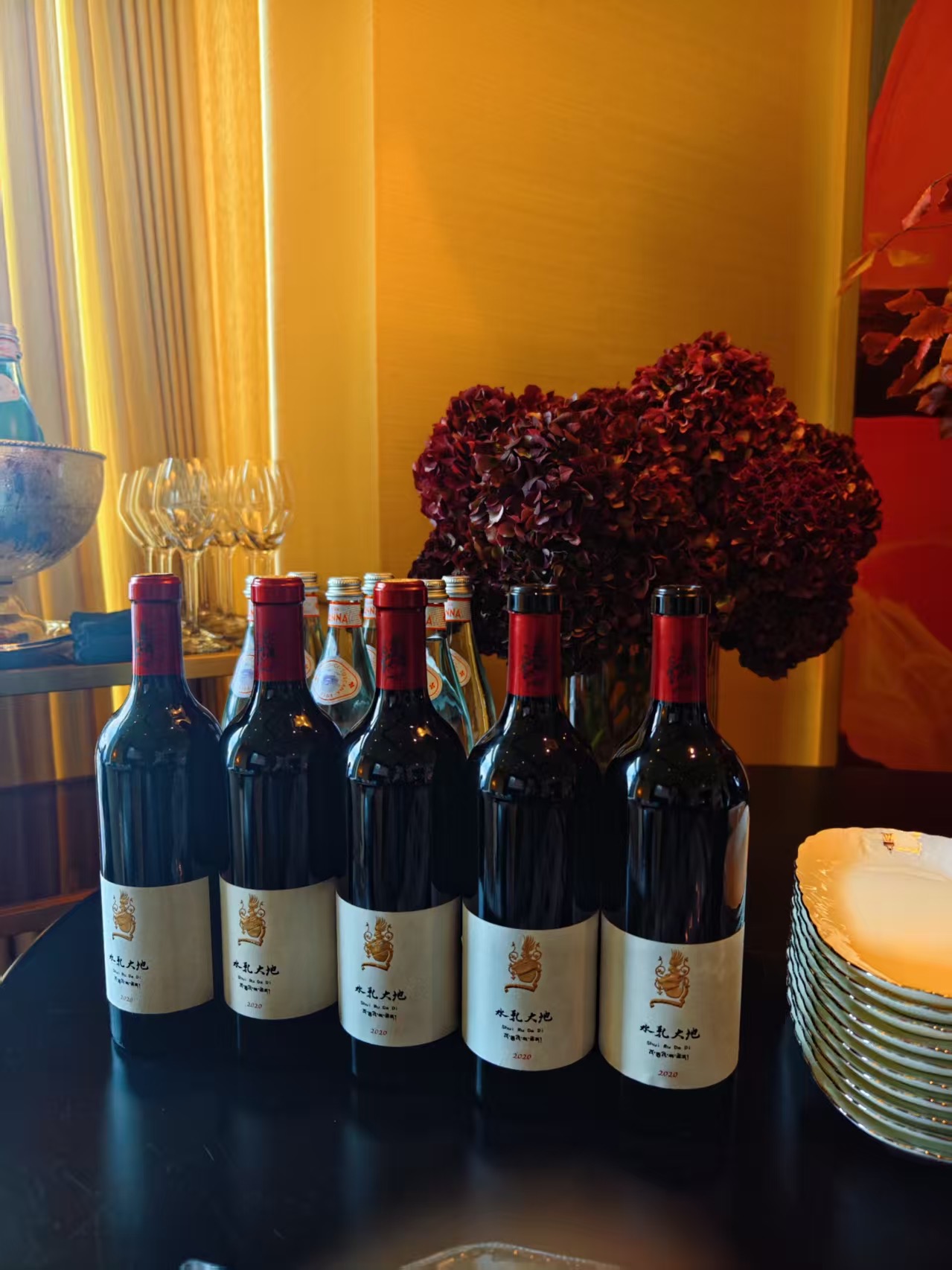
First stop was the Flying Tiger wine centre — I know the owner. Hwan had brought a bottle of 水乳大地, his gift for a Japanese elder he respects. That elder has probably never tasted Chinese wine at this level. Giving a bottle of 水乳大地 to someone with no expectations of Chinese wine is a particular kind of pleasure: it will revise one of their assumptions about China.
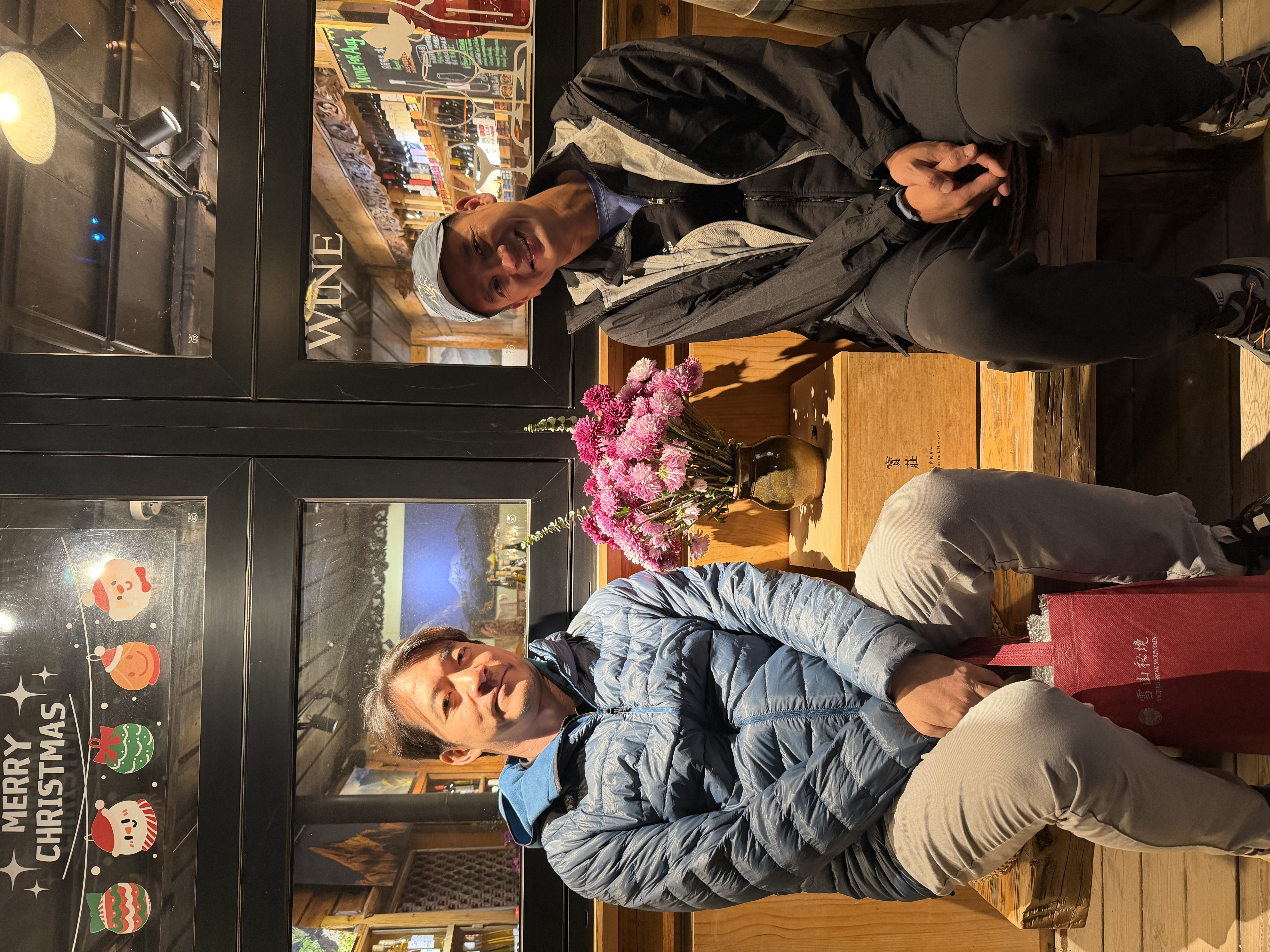
After that, Hwan wanted a good coffee. In the commercial district of Shangri-La old town, this was harder than you would expect — tourist-facing chain cafes and milk tea shops everywhere, but a place that took coffee seriously required finding a less commercial corner. We searched for a while. I walked into a café that had no one inside.
The girl from the neighbouring shop saw me and went to call the owner. The owner was a young man, slightly shy. He came out, greeted me politely, and said upfront that his beans were imported and industrially roasted — probably not what Hwan was looking for. Hwan's interest did, indeed, reduce slightly.
Then the young man looked at me, paused, and said: "Have I served you before? Your face is very familiar."
The fifteen seconds it took him to make the connection were visible on his face. He remembered. He said: "You came here before, didn't you?" I said yes. He said: "I am the owner of the photography studio next door."
I remembered him. Among the photography studios in Shangri-La old town, his was the one with the most considered aesthetic — not a standard studio photographing tourists in Tibetan costume, but a place that took Tibetan visual culture seriously. His studio priced accordingly, with costumes rented separately. The last time, he had introduced me to several Tibetan heritage craft brands I had not known existed — things that occupy in Tibetan culture the position equivalent to LV in European culture, almost entirely unknown outside.
We stood at the doorway and talked for a while. He said he was currently running the café alongside the photography studio, both slowly, both finding their own rhythm. I said next time I came, I would look for him again. He nodded in a way that told me he believed the promise was real.
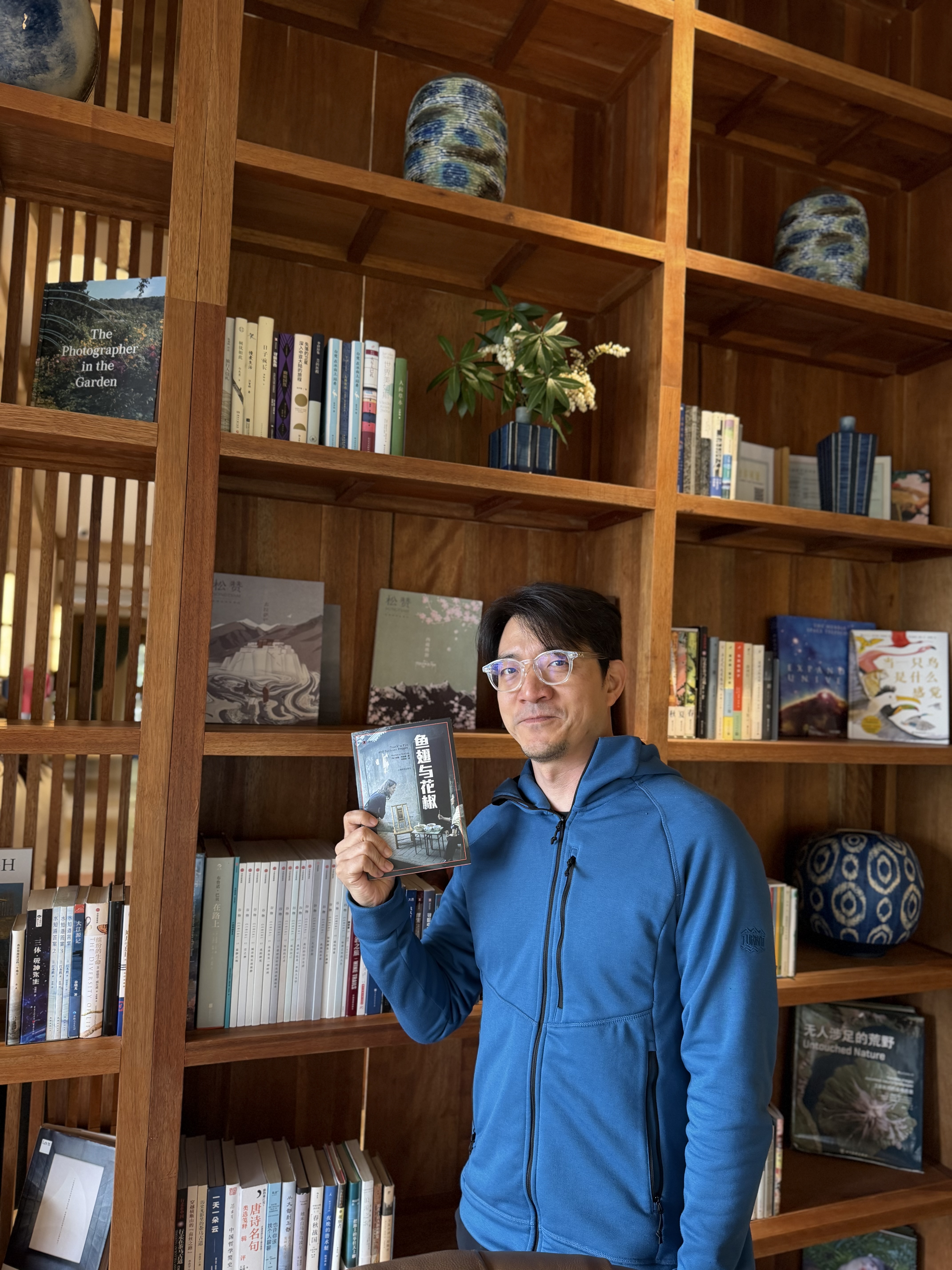
The last stop was the Pioneer Bookstore — 先鋒書店. A Nanjing-origin independent bookstore brand that has opened locations in some of the most unexpected places in China, each with its own architectural design, each maintaining a considered curation standard. The Shangri-La branch, inside the old town, centres its selection on nature, ecology, southwestern geography, and Tibetan culture.
I stood at the shelves and picked up 水乳大地 — Fan Wen's epic novel of Tibetan history, spanning a century across the Lancang River basin. The title comes from a Tibetan image: the land where water and milk merge into one, inseparable. This book is hard to find in Hong Kong. Here it was on the shelf.
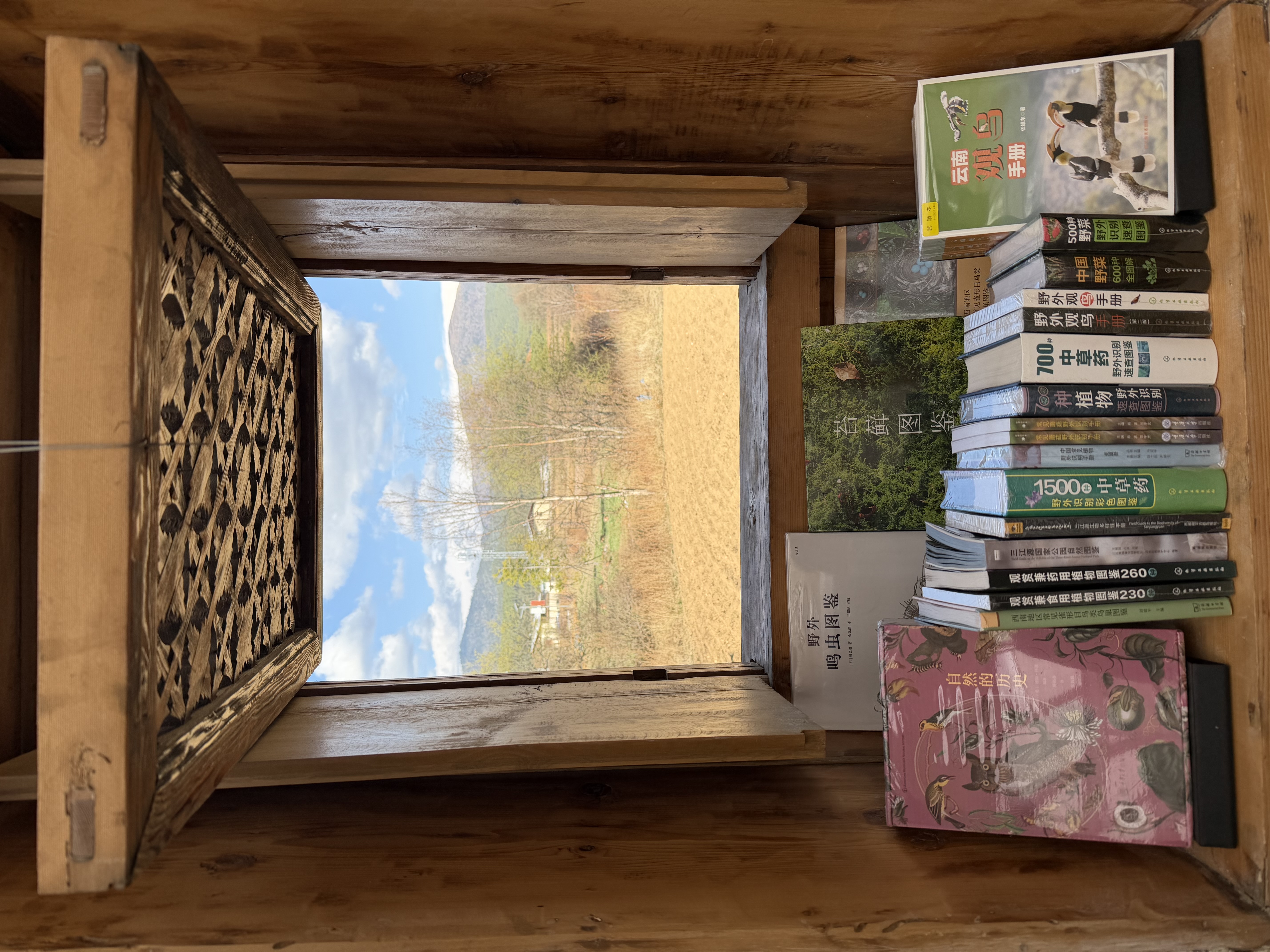
By the window, a stack of field guides — birds, plants, mammals — all focused on the southwestern ecosystem. Through the carved lattice window, a view of the valley and distant vineyard. The knowledge on the shelves and the knowledge outside the window are the same thing — one bound between covers, one still growing.
I stopped at the section on birds and pulled out a field guide to southwestern Yunnan species, turning to the Lancang River basin pages. This region has one of China's highest levels of avian diversity — the Three Parallel Rivers corridor functions as both a migratory flyway and a permanent habitat across multiple ecological zones, from subtropical valley floor to high-altitude conifer forest. Some species in the guide I had seen on this trip: the heron that had paused on the riverbank in Benzilan, the swifts circling a church rooftop, and somewhere near the vineyard edge on Meili Snow Mountain, a flash of rufous-red wings I had noticed but couldn't name. The guide told me it was probably a Rufous-bellied Redstart.
The relationship between knowledge diversity and biological diversity is not merely metaphorical. Scientists studying biodiversity have found that preserving a language, a local knowledge system, or a traditional agricultural practice is often the same work as preserving a species' habitat — because local knowledge is itself the product of centuries of interaction between people and an ecosystem, and its disappearance often means the ecosystem loses the people who understood it best. The Pioneer Bookstore's choice to collect knowledge about this land, in this place, is not an incidental decision — it is the same act of preservation in a different medium.
The Pioneer Bookstore made me think for a long time. In one of the most remote corners of China, a bookstore chooses to exist here, maintains its own standard of what matters, refuses to lower that standard because of location. What it preserves is a form of knowledge diversity — knowledge about the biology, culture, and history of this land — the way this canyon preserves biological diversity itself. This is not coincidence. It is the same logic.
This journey ran from Hong Kong to Lijiang, from a few hundred metres of altitude to several thousand, and back to a few hundred. I saw barefoot elders on concrete roads, church crosses hidden in morning mist, yak mother and calf on a high mountain ridge, twenty minutes of sunrise on snow, the old timber and altar panels of Duomu, a whole valley's worth of people celebrating a new house, nature field guides beside a bookshelf window, and the face of a photographer running a café in Shangri-La.
Lily's bet in Benzilan, the Pioneer Bookstore's insistence in Shangri-La old town, the poet writing about mountains after retirement — these matter not because they are case studies in cultural conservation but because they are specific people, in a specific place, who believe certain things are worth continuing, and who show up every day to do it. What GutCommon does is the same thing, on the same land. To learn more about what GutCommon does, read our story.
水乳大地 — Fan Wen's novel — is almost impossible to find in Hong Kong. Part of the reason is ecological: the book is about a century of Tibetan history, staged along the Lancang River, spanning a geography and cultural range that most Hong Kong mainstream readers have never encountered. Books that write about small places are naturally limited in their circulation through large markets. This is the fate of local knowledge — it tends to circulate only in the place it came from, and only reaches people who are willing to go there. The Pioneer Bookstore's work is to hold this knowledge about a specific land, in the form of a bookstore, in that place.
I left the bookstore carrying 水乳大地 at the top of my bag, so nothing would press against it. From Shangri-La to Lijiang the drive takes two and a half hours, descending along the Jinsha River canyon — the logic of the valley is constantly narrowing and suddenly opening. I kept the book on my lap, unopened. I wanted to save it for Hong Kong. Some things only become clearer after distance.